Sydney Rentals: Who Cleans the Gutters?
The Argument That Starts Every August in Sydney
Every August our phone rings with the same argument. A tenant in Ryde has water sheeting over the eaves at the back door, the managing agent has told her gutter cleaning is a tenant expense, and the owner in Mosman assumed the strata levy covered it. Between the three of them, nobody has been up a ladder since the tenancy started in 2023.
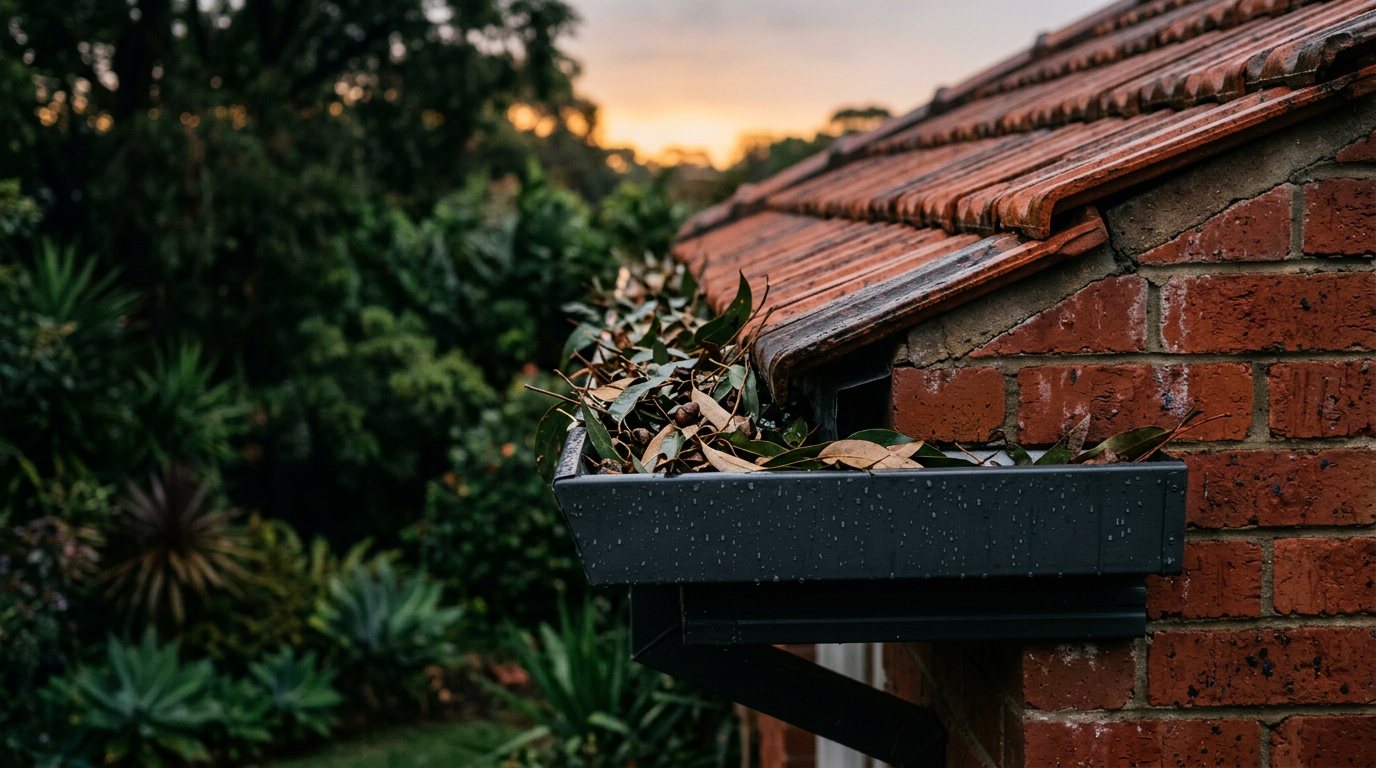
By the time we get there the trough is holding two seasons of gum leaves and a layer of black sludge, the fascia paint has blistered, and there is a soft patch of timber under the downpipe bracket. That job would have cost a few hundred dollars in 2023. It is now a clean plus a repair, and the two parties are arguing about who wears it.
The question underneath all of it is simple and it has a clear answer in New South Wales. Gutter cleaning on a rental property is a landlord obligation, not a tenant one, in almost every situation. What follows is the reasoning, the exceptions, the timeframes, and what both sides should do before Sydney's spring storm pattern arrives in late September.
What NSW Law Says About Gutters in a Rental
The starting point is the landlord's duty to provide and maintain the premises in a reasonable state of repair. That duty sits in the Residential Tenancies Act 2010 and it applies for the whole tenancy, not just the day the keys are handed over. NSW Fair Trading sets out the split plainly on its page covering repairs, maintenance and damage in a rental.
Gutters are part of the building's stormwater system. They are fixed to the structure, they protect the structure, and clearing them safely requires ladder work above the ground. That places them on the landlord's side of the line, in the same category as the roof, the eaves and the downpipes.
A tenant's duty runs the other way. Tenants must keep the property reasonably clean and must not damage it. Sweeping a courtyard, mowing a lawn and emptying a bin all fall inside that. Climbing four metres to remove decomposed leaf litter from a fixed part of the building does not.
Can a Lease Push the Job Onto the Tenant?
Agents sometimes add a special condition saying the tenant will maintain the gutters. A term like that carries very little weight. Under NSW residential tenancy law, an additional term cannot reduce or exclude a landlord's statutory repair obligations, and a term that is inconsistent with the standard agreement is unenforceable. The Tenants' Union of NSW covers the same ground in its repairs and maintenance factsheet.
There is a practical problem with those clauses as well. If a tenant falls off a ladder doing work the owner was legally responsible for, the insurance conversation that follows is not one any landlord wants to have.
Where the Line Sits: Three Common Sydney Scenarios
Most disputes are not really about the law. They are about who noticed the problem first and who is being asked to pay.
- Standalone house on a leafy street in Turramurra or Epping. Owner's responsibility, without qualification. Two cleans a year is the realistic baseline under gums.
- Townhouse or villa in a small strata plan. The owners corporation usually maintains common property, which normally includes the roof and gutters. The landlord still has to chase it, because the tenant has no standing to instruct strata.
- Duplex or granny flat with a shared roof. Owner's responsibility again, and worth coordinating with the neighbouring owner so the whole run is cleared in one visit rather than half of it.
The one genuine exception is damage. If a tenant blocks a downpipe with something they put there, or breaks a bracket, the repair cost can sit with them. Ordinary leaf fall is not damage. It is weather, and weather is the owner's problem.
Why This Costs Owners More Than Any Other Skipped Job
Deferred gutter cleaning is the cheapest maintenance item to skip and one of the most expensive to catch up on. The sequence is predictable and we see it in the same order every spring.
- Debris builds through autumn and winter. Gum leaves, bark strips, jacaranda litter and seed pods compact into a mat that holds water between storms.
- The trough stops draining. Standing water sits against the metal, and on the coast salt accelerates the corrosion from there.
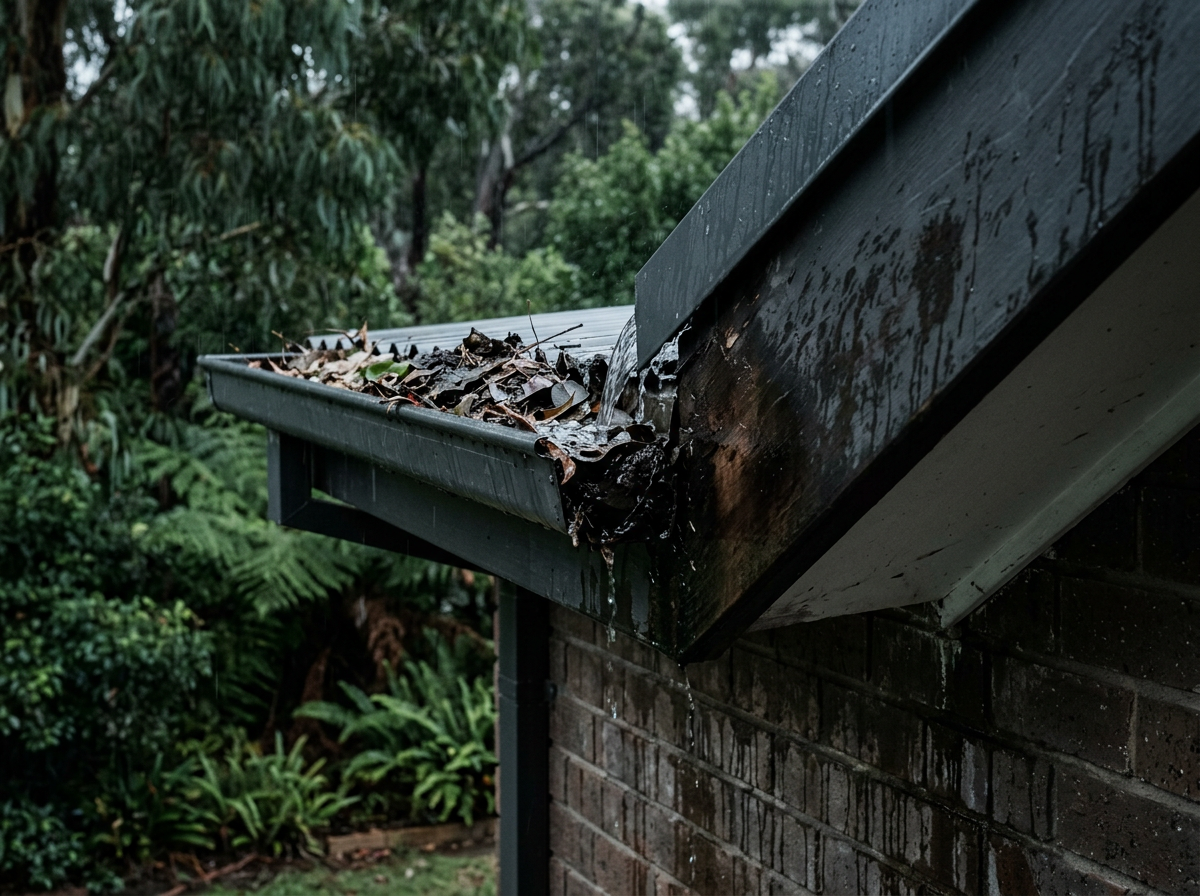
- Overflow goes over the back edge. Not the front. Water runs behind the fascia into the eaves cavity, which is why the first sign is usually inside.
- Timber stays wet. Fascia and soffit lining absorb it, paint blisters, and the substrate softens over a couple of seasons.
- The repair bill arrives. Replacing a rotted fascia run and re-hanging the gutter costs several thousand dollars on a typical Sydney home.
There is an insurance layer on top. Australian home and landlord policies cover sudden storm damage, but almost all of them exclude gradual damage caused by lack of maintenance. When an assessor photographs a gutter packed with two years of debris, the claim gets difficult fast. We walk through the wording and the evidence that keeps a claim alive in our guide to storm insurance claims denied over gutter maintenance.
The Timing Question: Why Mid August Matters
Sydney's rainfall does not spread itself evenly. Bureau of Meteorology climate averages for Observatory Hill show the wet months clustering from late summer through autumn, but the pattern that catches rentals out is the spring change. Late September through November brings short, intense convective storms that dump a lot of water in a few minutes.
A gutter can cope with steady winter drizzle while half blocked. It cannot cope with 20 millimetres in fifteen minutes. That is the moment a marginal system fails, and it is why a clean booked in August behaves completely differently to one booked in October.
There is a scheduling reality too. Once the first big spring storm hits, every roof plumber and gutter crew in the basin is booked for a fortnight, and the jobs at the front of the queue are the ones with water already inside. Owners who book in August get a routine clean at a routine price. Owners who wait get an emergency call-out during a leaf season that has already done the damage.
The Pre-Storm Checklist for Managed Properties
- Book the clean before the end of September, ahead of the first convective storms.
- Get date-stamped before-and-after photographs filed against the property record.
- Have downpipes flow tested, not just the trough cleared.
- Check the gutter fall while the crew is up there, since sagging runs pond water permanently.
- Note any rust perforation or failed joins now, while a repair is still small.
- Repeat every six months on properties under eucalypts, annually elsewhere.
What a Tenant Should Actually Do
If you are renting and the gutters are overflowing, the process is short and it works best in writing.
- Photograph it during rain. Video of water running over the back edge is far more persuasive than a photo of leaves.
- Report it in writing to the agent or landlord. Email or the portal, never a phone call alone. The written record is what starts the clock.
- Describe the consequence, not just the cause. Water entering the eaves, a damp patch on a bedroom ceiling, or pooling against the slab all carry more weight than "the gutters look full".
- Ask for a timeframe. Non urgent repairs should be attended to within a reasonable period. Where water is entering the building, argue that it is urgent.
- Escalate if nothing happens. NSW Fair Trading offers a free tenancy complaint and mediation service, and unresolved matters go to the NSW Civil and Administrative Tribunal.
What a tenant should not do is get on a ladder. Falls from height are one of the largest causes of serious injury in NSW, which is why SafeWork NSW publishes specific guidance on working at heights. A rental tenant has no duty to take that risk and no insurance cover if it goes wrong. Our breakdown of the real risk in DIY gutter cleaning has the numbers.
What a Landlord or Property Manager Should Put in Place
The owners who never have this argument treat gutter cleaning as a scheduled service rather than a reactive repair. Three things make the difference.
- A standing schedule. Twice a year under gums, once a year on a clear block. Booked in advance so it happens whether or not anyone complains.
- A paper trail. Invoices and photographs filed with the property record. This is the single most useful thing you can hold if a storm claim is ever questioned.
- A whole-of-system check. Cleaning without checking falls, joins and downpipe capacity leaves the underlying fault in place.
Cost is not the barrier people expect. A standard single-storey Sydney clean starts around $199, and a two-storey property typically lands between $299 and $450 depending on roof access and debris load. Full pricing is on our gutter cleaning cost guide for Sydney. Against a fascia replacement or a rejected insurance claim, it is the cheapest line item on the property.
For properties surrounded by eucalypts, the maths shifts toward prevention. Quality mesh installed to the roof profile removes most of the annual clearing, and we cover the products and the price per metre in our gutter guard guide for Sydney homes.
Does Any of This Show Up on the Water Bill?
Owners often ask whether an overflowing gutter costs them anything in water charges. It does not. Rainwater was never metered, so it cannot appear as usage, and it does not qualify for Sydney Water's concealed leak concessions either.
Where the bill does matter is context. Sydney Water's current prices have climbed under the latest determination, which has pushed more Sydney landlords toward rainwater tanks on investment properties. A tank fed by a filthy gutter is a liability rather than a saving, because the first flush carries leaf tannins, bird droppings and grit straight into storage. We explain the contamination path in our article on rainwater tank contamination from dirty gutters.
Compliance and the Building Side of the Argument
There is a second reason gutter maintenance sits with the owner. Roof drainage on Australian homes is designed to a standard, AS/NZS 3500.3, which is referenced through the National Construction Code published by the Australian Building Codes Board. That standard sets gutter capacity and downpipe spacing for a given roof area and rainfall intensity.
A system built to that standard only performs when it is clear. Fill a trough with 40 millimetres of compacted leaf mat and you have taken a large share of its designed capacity away. The building no longer performs as approved, and that is squarely an owner responsibility.
It also explains why some Sydney rentals overflow even after a clean. Older homes in the inner west and lower north shore were often built with too few downpipes for the roof area, and no amount of cleaning fixes an undersized system. Our downpipe sizing guide shows how to work out whether the property has enough capacity.
Bond, Exit Reports and the Gutter Photograph
The other place this argument surfaces is at the end of a tenancy. Outgoing inspection reports increasingly include roofline photographs, and a gutter full of debris gets written up as a cleanliness item even though it is a maintenance one.
Tenants should push back on that, politely and in writing. Leaf litter accumulating on a fixed part of the building is not a failure to keep the property reasonably clean, and a bond claim on that basis is unlikely to survive at NCAT. The same logic applies to a mossy roof, a stained fascia or a rusted downpipe.
Landlords have a genuine interest here too, and it runs in the other direction. An exit report is the cleanest opportunity in the whole tenancy cycle to get the roofline serviced while the property is vacant. Access is easy, nobody is inconvenienced, and the incoming tenant starts with a system that works.
The Vacancy Window Nobody Uses
- Book the clean between tenancies. No access negotiation, no notice period, no coordination with a tenant's schedule.
- Photograph the roofline on the entry condition report. It removes any argument about who let it get that way.
- Fix small defects while the scaffold or ladder is already up. Re-sealing a join or re-bracketing a sagging run costs a fraction of doing it as a separate visit.
- Record the service date on the property file. Most agencies track smoke alarms and pest control this way already and simply have no field for gutters.
Sydney's rental vacancy rates have been tight for several years, which means most properties turn over quickly and that window is short. Agencies that build gutter cleaning into the vacate checklist get it done in the two or three days between tenancies. Everyone else waits until a tenant complains, which is usually mid storm.
There is a compounding benefit. A property with a documented maintenance history is easier to insure, easier to sell, and far easier to defend at the tribunal. Buyers' building inspectors read a clean roofline as a sign the whole property has been looked after, which we cover in our guide to the gutter faults flagged in pre-sale inspections.
Settling It Without a Dispute
Most of these arguments end quickly once someone puts the facts on the table.
- The landlord owns the building, so the landlord owns the gutters.
- The tenant owns the mess they make, not the leaves the trees drop.
- A lease clause cannot move a statutory repair duty onto the tenant.
- A written request starts the clock and creates the record.
- Photographs before and after protect both parties.
Property managers who want the whole portfolio handled in one pass can book multiple addresses on the same run, which is how most of our agency clients in Chatswood, Manly and Gosford work through August and September.
Book the Clean Before the First Spring Storm
The window that matters closes at the end of September. Right now the debris from winter is still sitting in the trough, the damage is still cosmetic on most properties, and crews are still available at standard rates. Four weeks from now, the first serious storm will decide which of those properties has a maintenance job and which has a repair.
GutterFlow services rental portfolios and owner-occupied homes across Sydney, the Central Coast, Newcastle and the Hunter. Every job comes with date-stamped before-and-after photographs you can file against the property record or attach to an insurance claim. Check your suburb on our service areas page, see what is included in our gutter cleaning service, or request a quote and we will get a crew out this week.
Need Your Gutters Cleaned?
GutterFlow Solutions provides fast, professional gutter cleaning across Sydney, Central Coast, Newcastle & the Hunter Region.