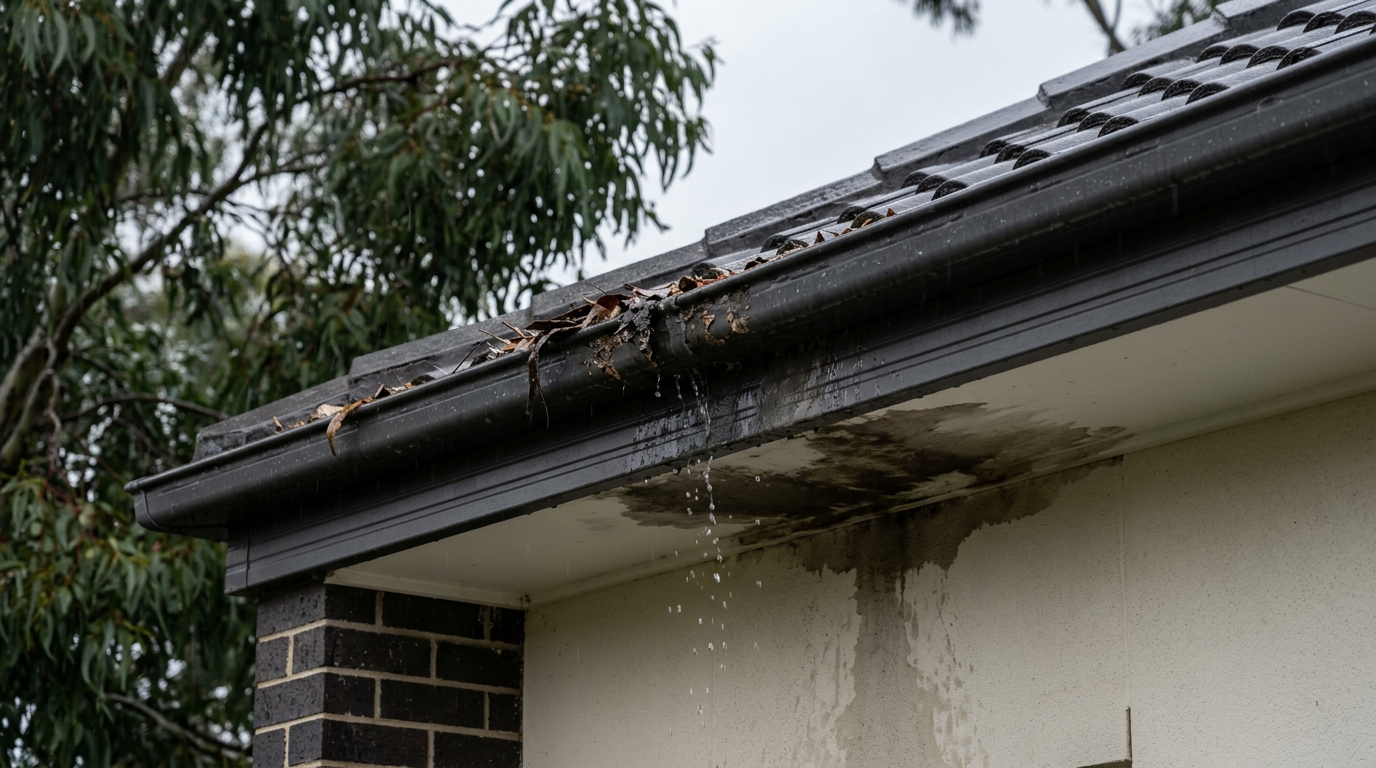
Sydney Roof Leaks: When Gutters Are the Real Cause
The Leak That Starts Outside the Roof
Ring a Sydney roof plumber in August and you will hear the same line before they have even seen your house: it is probably not the roof. After a winter of East Coast Lows pushing rain sideways across the Northern Beaches and up the Parramatta River corridor, most of the ceiling stains that appear in late winter start in the gutter, not in the tiles above it.
That distinction matters because it changes the repair bill by thousands of dollars. A homeowner in Ryde who books a re-roof for a stain in the hallway ceiling is often paying to fix a symptom while the cause keeps running every time it rains. Meanwhile the actual fault sits fifty centimetres away in a gutter trough packed with two winters of gum leaves.
Late winter is when this shows up. The soil is saturated, the roof cavity has not dried out between storms, and paint that held on through June finally lifts. If you are seeing a new stain this month, the next few weeks before spring rain arrives are the cheapest window you will get to deal with it properly.
Why Sydney Roof Leaks Behave Differently to Everywhere Else
Sydney gets its rain in short, violent bursts rather than steady drizzle. The Bureau of Meteorology's Observatory Hill records show the city averaging well over a metre of rain a year, and a large share of it arrives in a handful of storm days. A gutter that copes fine with light rain can be completely overwhelmed in twenty minutes.
Add the tree canopy. Eucalypts drop leaves and bark year round instead of once in autumn, so a Sydney gutter never gets a clean season. Jacarandas, camphor laurels and paperbarks all shed into the same trough, and by August that mix has broken down into a dense, water-holding mat rather than loose leaves you could lift out by hand.
Then there is the housing stock. Federation homes in Haberfield, war-service brick in Sutherland Shire, and post-war fibro across the Central Coast all use eaves and fascia details that were designed for far smaller volumes of water than a blocked gutter delivers.
The result is a specific Sydney failure pattern. Water backs up in the trough, rises above the back edge of the gutter, and runs behind the fascia straight into the roof cavity. From there it travels along a rafter or a batten before it drops, which is why the ceiling stain almost never appears directly under the fault.
The Six Gutter Faults Behind Most Sydney Roof Leaks
Roof plumbers see the same short list over and over. Each of these puts water inside the building envelope without a single broken tile:
- Back-edge overflow. Debris lifts the water level above the gutter's rear lip, and the overflow runs down the fascia and into the eaves rather than off the front.
- Blocked downpipe outlets. The trough itself looks passable, but the outlet is plugged with compacted leaf litter, so the whole run holds water like a bathtub.
- Negative fall or a sagging run. Bent brackets or a run laid with the wrong fall leave standing water on a dry day, which corrodes the base and finds every join.
- Failed joins and corner seals. Sealant in an internal corner has a working life, and once it goes the leak sits directly above a wall cavity.
- Rust perforation at the base. Common on older galvanised gutters and on any coastal run at Manly, Dee Why or Terrigal where salt accelerates the process.
- Valley and box gutter blockage. Debris in a roof valley pushes water sideways under the tiles, which produces a leak metres away from the blockage.
The last two carry the highest repair costs, because they usually go undetected until the timber underneath has already gone soft. Our guide to box gutter overflow in Sydney terraces covers that failure mode in detail for anyone with an internal gutter.
How to Tell a Gutter Leak From a Roof Leak
You can narrow this down from the ground before anyone quotes you. The tests below take about twenty minutes and cost nothing.
Watch the Timing
A true roof leak drips within minutes of rain starting, because water is landing on a broken tile or a failed flashing and going straight through. A gutter-driven leak needs volume before it overtops the back edge, so it usually starts fifteen to thirty minutes into heavy rain and keeps running after the rain stops.
Look at the Stain Shape
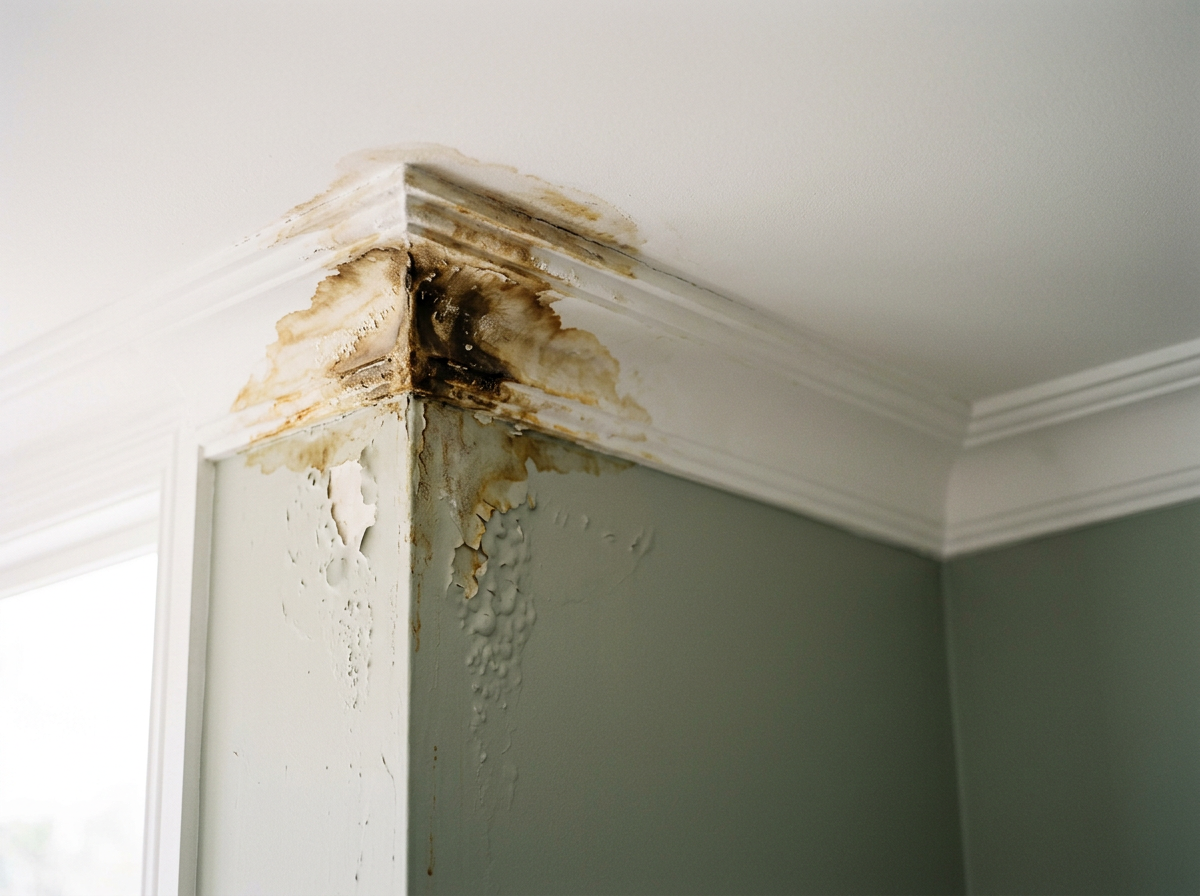
Roof leaks tend to produce a round, centred stain that grows outward from a single entry point. Gutter overflow produces a stain that starts at the wall junction or the cornice and spreads inward, because the water entered at the eaves line and tracked along the top plate.
Check the External Wall
Walk the perimeter after rain and look for dark vertical streaking on render or brick directly under a gutter join. That streaking is the clearest ground-level evidence of back-edge overflow, and it is the same marker building inspectors photograph first.
Inspect the Eaves Lining
Sagging, staining or mould on the underside of the eaves means water has been sitting in that cavity repeatedly. NSW Health's guidance on mould treats persistent indoor mould as a health issue to be fixed at the moisture source, which in this case is almost always the gutter above it.
Test the Downpipes
During rain, check that every downpipe is discharging strongly. A downpipe running weakly while the gutter above it is brimming tells you the outlet is blocked, and that single observation solves a large share of Sydney leak call-outs.
What the Damage Costs When You Leave It
The gutter fault itself is cheap. What it feeds is not.
Water sitting against a fascia board rots the timber the gutter is screwed to, so the eventual repair is a fascia replacement plus a re-hang rather than a clean, and that is a full-day job on most homes. We break the timber sequence down in our piece on fascia and soffit rot.
Inside, repeated wetting of plasterboard means the ceiling sheet is replaced, not patched, once the paper facing has delaminated. Add cornice, paint and the electrician's call-out if the water reached a downlight, and a domestic ceiling repair in Sydney regularly lands between two and five thousand dollars.
There is an insurance angle too. Storm damage is covered, but gradual water damage from a lack of maintenance is excluded in most Australian home policies, and the Insurance Council of Australia is clear that maintenance obligations sit with the property owner. A dated cleaning invoice is the evidence that keeps a claim alive.
The Sydney Water Bill Question
Owners often notice a higher bill in the same quarter the stain appears and assume the two are connected. They usually are not, because rainwater running through a roof cavity was never metered.
The confusion is worth clearing up while you are looking at costs, because Sydney Water prices have moved. The Sydney Water price proposal sets out the increases now flowing through to household bills, which makes any unexplained jump feel alarming.
If your bill has genuinely risen without a change in habits, the relevant relief is the Hidden Leak Allowance. It applies to concealed leaks in your own metered pipework, not to roof or gutter water, and it requires a licensed plumber's repair before Sydney Water will consider a credit. Treat the two problems separately: get the plumber onto the metered leak, and get the gutter cleared before the next storm. Our water bill explainer covers where the two genuinely do intersect.
Compliance: What a Correct Repair Actually Involves
Roof drainage is regulated, and a proper repair follows the same rules as new work. Roof plumbing and stormwater design in New South Wales sit under AS/NZS 3500.3 and the National Construction Code, which set minimum downpipe capacity, gutter sizing and overflow provisions for the rainfall intensity of your location.
Two practical points come out of that for Sydney homes:
- Gutters must have a defined overflow path that discharges away from the building, so water spills outward instead of backward into the eaves.
- Downpipe numbers are set by catchment area and local rainfall intensity, so a home extended in the last twenty years often has too few downpipes for its new roof area.
If your leak keeps returning after cleaning, undersized drainage is the likely reason, and that is a design fix rather than a maintenance one. Our gutter installation service sizes replacements to the standard rather than matching whatever was there before.
Why Chasing This Yourself Is the Wrong Call in August
Wet tiles, moss on the north side, and a ladder on soft late-winter soil is the worst combination in domestic maintenance. SafeWork NSW treats any work above two metres as a fall risk requiring proper controls, and most Sydney rooflines clear that easily.
There is also a diagnostic problem. Finding a back-edge overflow means watching water behave during rain or reading the staining pattern inside the cavity, and neither is visible from a ladder on a dry Saturday. Homeowners routinely scoop the visible leaves, declare it fixed, and get the same stain in September because the outlet was never cleared.
If you want the safety detail before deciding, our DIY ladder risk guide sets out what goes wrong and how often.
The Fix Sequence That Actually Stops the Leak
Order matters here. Doing these out of sequence is how people pay twice.
- Full clear and flush. Every trough, every outlet, every valley, with water run through afterwards to confirm flow. A professional gutter clean is the diagnostic step as much as the maintenance one.
- Wet test. Flood the run with a hose and watch where water goes. This is what separates a blocked outlet from a failed join.
- Targeted repair. Re-seal joins, correct the fall, replace perforated sections, or re-bracket a sagging run. Gutter repairs at this stage are far cheaper than replacement.
- Capacity check. Compare downpipe count and gutter profile against the roof area, and add outlets where the maths says the run cannot cope.
- Prevention. Fit gutter guard on runs under heavy canopy so the same eucalypt load does not rebuild by summer.
- Interior repair last. Only patch the ceiling once the cavity has dried and the source is confirmed fixed, otherwise you will be repainting in autumn.
For homes on tank water or with delicate roof sheeting, gutter vacuuming removes the load without flushing sediment into the tank or walking the roof.
Where We See This Most Across Sydney and the Central Coast
The fault is the same everywhere, but the trigger changes by suburb, and knowing your local trigger tells you how often the problem will come back.
Leafy North Shore and Hills District
Chatswood, Hornsby, Killarney Heights and the streets running off the Lane Cove valley sit under mature eucalypt and camphor laurel canopy. Gutters here fill from above and from the side, and the debris is fine and fibrous rather than chunky, so it packs into outlets rather than sitting loose in the trough. Two cleans a year is the realistic baseline, and most leak call-outs in these suburbs trace back to a plugged outlet rather than a damaged gutter.
Coastal Runs from Manly to Terrigal
Salt does the damage here. Airborne salt accelerates corrosion on the base of the trough and on fixings, so the failure mode is perforation and join failure rather than pure blockage. A gutter that looks clean can still be leaking through a rust pinhole at a bracket point, and once that starts the fascia behind it is already taking water.
Inner West Terraces and Federation Homes
Haberfield, Marrickville, Petersham and the surrounding terrace belt run box gutters and internal valleys behind parapets. There is no visible overflow point, so the first sign is usually an interior stain rather than streaking on the wall. These are the highest-risk properties in Sydney for a slow, expensive leak.
Central Coast Fibro and Post-War Stock
Woy Woy, The Entrance, Gosford and Erina have a high share of older low-pitch roofs with shallow gutter profiles and minimal downpipes. Low pitch means water moves slowly, and slow water plus a shallow trough overtops early in a storm. Adding a downpipe is often a bigger improvement than replacing the gutter.
What a Proper Diagnosis Looks Like on Site
A useful inspection produces evidence, not opinions. When a crew is on your roof for a leak, these are the things that should come back to you.
- Photographs of every trough section before and after clearing, with the outlet visible in the frame.
- A recorded flow test on each downpipe, noting any run that holds water once flushed.
- A note on gutter fall, taken with a level rather than by eye, on any run showing standing water.
- Close-ups of joins, internal corners and bracket points where rust or sealant failure is visible.
- Condition notes on fascia and eaves lining directly under any staining, so you know whether timber work is coming.
- A downpipe count against roof area, flagged where the run is short on capacity for the catchment.
Keep that record. It is what an insurer asks for after the next storm, and it is what a building inspector reads if you list the property in spring.
Timing: Why the Next Six Weeks Matter
Spring in Sydney brings two things at once. The first southerly storm systems of the warm season arrive from late September, and the spring property market opens with them, which means every roof plumber and gutter crew in the basin is booked out.
Late winter is also the only point in the year when the evidence is still readable. Staining is fresh, timber is still damp enough to probe, and the debris that caused the overflow is still sitting where it caused it. Wait until November and the trough has dried into a compacted crust that hides the fall problem underneath.
Book the clean and the wet test now, and you get a diagnosis while the fault is still cheap. Wait for the first real spring storm, and you get an emergency call-out rate plus a ceiling repair.
Get the Cause Diagnosed, Not the Symptom Patched
A ceiling stain is information, not a verdict. In most Sydney homes it points at a gutter that filled, backed up and sent water somewhere the building was never designed to take it, and the fix is a clear, a wet test and a targeted repair rather than a roof replacement.
GutterFlow works across Sydney, the Central Coast, Newcastle and the Hunter, and every job includes photographic before-and-after evidence you can file for insurance. Check whether we cover your suburb on our service areas page, or request a quote and we will get a crew out before the spring storms start.
Need Your Gutters Cleaned?
GutterFlow Solutions provides fast, professional gutter cleaning across Sydney, Central Coast, Newcastle & the Hunter Region.