Why Your Buyer Will Read About Your Gutters Before They Read Anything Else
Sydney agents lock in spring campaigns from the second week of August, and the building and pest report is usually commissioned within days of the listing agreement. The inspector arrives, walks the perimeter, and starts photographing at the roofline before they have opened a single internal door.
That order is deliberate. Roof drainage is the single most reliable predictor of the expensive problems hiding inside a Sydney house, so it sets the tone for the entire report. A gutter full of decayed gum leaves and a fascia board with paint blistering off it tells an inspector to look harder at everything else.
By late July the damage from an East Coast Low winter is fully visible and has not yet been washed clean by spring rain. Timber has swelled, staining has set, and rust lines are at their most obvious. If you are listing between September and November, the window to fix this quietly is the next four to six weeks.
What a Building Inspector Actually Checks at the Roofline
Pre-purchase inspections in New South Wales are carried out to AS 4349.1, which sets the scope for residential property reports. Roof drainage sits inside that scope, and inspectors are trained to record specific, photographable defects rather than general impressions.
The roofline checklist usually covers:
- Debris load in the gutter trough, measured by depth and by how far it extends past the downpipe outlets.
- Standing water sitting in the trough on a dry day, which indicates fall problems or a sag.
- Rust perforation along the base of the gutter, especially at joins and internal corners.
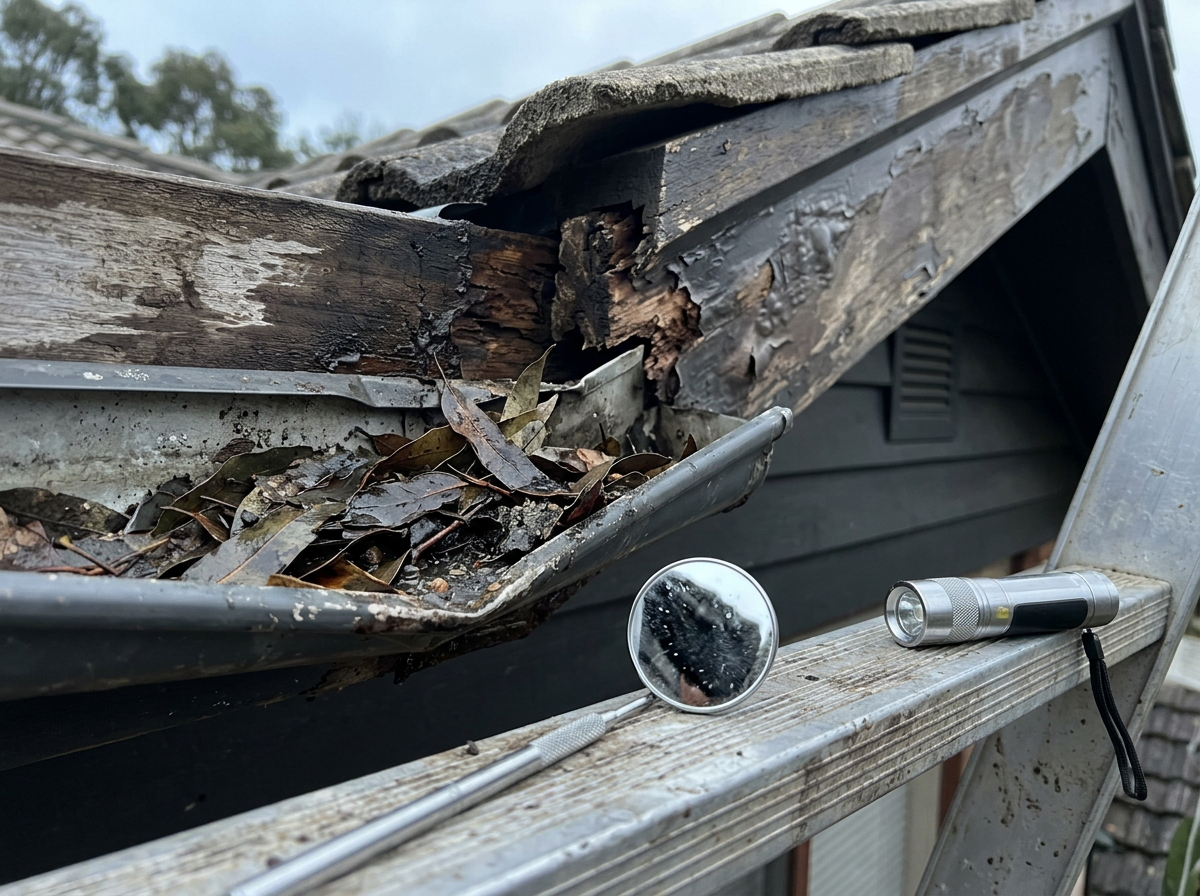
- Fascia board condition, including paint blistering, soft timber, and separation from the gutter bracket line.
- Downpipe connection at ground level, and whether it discharges into a stormwater system or straight onto soil.
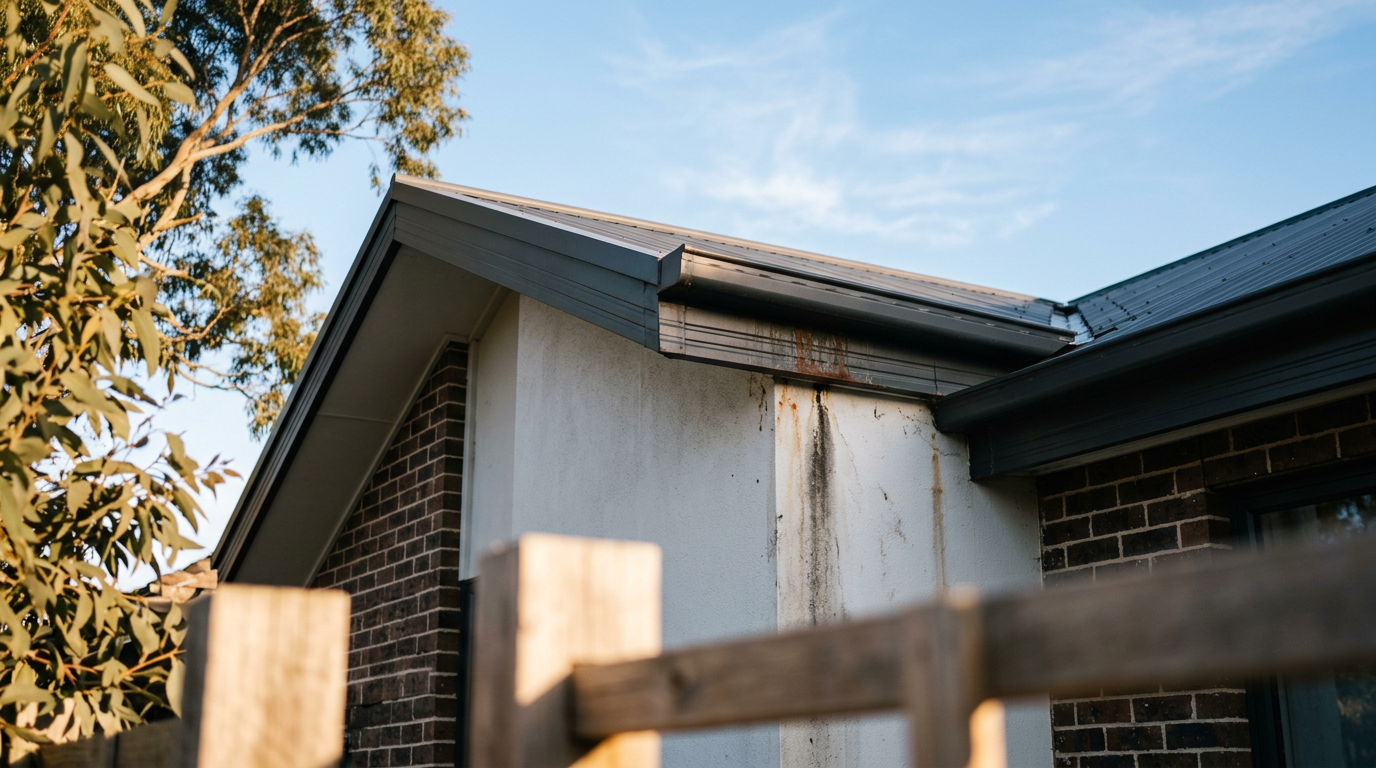
- Overflow staining on external walls under gutter joins and box gutter outlets.
- Eaves lining sagging, staining, or showing mould growth on the underside.
- Roof valleys packed with leaf litter, which pushes water sideways under tiles.
Each of those items gets a photograph and a severity rating. Buyers do not read the technical wording. They read the photographs, and they count how many of them show the same brown water stain.
How Buyers Price a Roofline Defect
This is where a two hundred dollar problem becomes a twelve thousand dollar problem. A buyer holding a report with three roofline photographs does not price the gutter. They price the worst thing the gutter could have caused.
The mental arithmetic runs roughly like this:
- The gutter is blocked, so it has probably been overflowing for at least one winter.
- Overflow means water has been running behind the fascia and into the eaves.
- Water in the eaves means potential timber rot, potential ceiling damage, and potential mould.
- None of that is visible without opening the eaves, so it is unquantified risk.
- Unquantified risk gets a conservative allowance in the offer, and conservative means large.
We have seen Sydney buyers deduct ten to fifteen thousand dollars from an offer over defects that cost under two thousand to rectify properly. The deduction is not about the repair. It is about the buyer refusing to carry unknown risk on a property they have not lived in.
The same logic applies at auction, except it happens invisibly. Registered bidders who read the report simply stop bidding earlier, and you never learn why the room went quiet at a number below reserve.
The Five Faults That Cost Sydney Sellers the Most
Not every roofline note carries the same weight. These are the five that consistently move price in Sydney reports.
1. Fascia rot behind the gutter line
Soft, blistered or delaminating fascia timber is the most damaging single finding, because it proves the overflow has been going on for years rather than months. Inspectors probe it with a screwdriver and photograph the depth. Once rot is confirmed, buyers assume the rafter tails behind it are also affected, and that assumption is often correct. The full picture on how this develops is covered in our guide to fascia and soffit rot caused by overflowing gutters.
2. Rust perforation at gutter joins
Coastal and near-coastal Sydney homes carry salt loading that attacks gutter steel from the inside where wet debris sits against it. Perforation at a join means the section is at end of life, and a buyer will price a full gutter replacement rather than a repair. Sound sections can usually be saved with targeted gutter repairs if the work is done before the rust runs the length of the run.
3. Downpipes discharging onto soil
An inspector will note any downpipe that ends at ground level without a connection to stormwater. On the reactive clay across western and south western Sydney, that finding sits directly beside any wall crack in the report, and the two get read together. It is the cheapest item on this list to correct and one of the most damaging to leave in place.
4. Standing water in the trough
Water sitting in a gutter on a dry day means the fall is wrong, the gutter has sagged off its brackets, or the outlet is choked. Inspectors photograph the waterline because it also indicates mosquito breeding habitat, which drags the report into a health note rather than a maintenance note.
5. Overflow staining on rendered walls
Render holds water staining permanently once it has set, so this defect survives cleaning and repainting is the only fix. Buyers reading a stain photograph assume active, ongoing overflow even after the gutter has been cleared, which is why the stain needs to be dealt with at the same time as the cause.
The Sydney Water Bill Problem Nobody Warns Sellers About
There is a second document buyers now read closely, and it has nothing to do with the building report. It is the water bill.
Sydney Water prices stepped up again from 1 July, and the increase applies across both the service charge and the usage charge. Buyers requesting the last four quarters of billing during the contract stage have become normal practice in Sydney, particularly for properties over about 1.8 million. A bill that sits well above the household average for the suburb reads as a red flag, and it is usually read alongside the roofline photographs rather than separately.
This matters for gutters in a way most sellers do not expect. The Hidden Leak Allowance is the Sydney Water concession that credits part of the water lost through an undetected leak on a customer's own pipework. It is worth understanding before you list, for three reasons.
- The allowance applies to concealed leaks on your property, not to water entering your home through overflow or damp, so gutter damage produces the damp without producing the credit.
- Applying for it requires a licensed plumber's report confirming the leak was hidden and has been repaired, which puts a dated document on file that a buyer's solicitor can request.
- Sellers who assume a high bill will be quietly absorbed by the allowance often discover during the contract stage that it will not be, and the bill becomes a negotiating point at the worst possible moment.
The practical position is straightforward. If your bills are unusually high, establish the cause and document the fix before you list. If your bills are normal but your walls show damp, that damp is coming from outside the pipe network, and the roofline is the first place to look. We covered the mechanism in detail in our breakdown of how blocked gutters inflate Sydney water bills.
What the Standards Say, and Why Inspectors Quote Them
Roof drainage in Australia is governed by AS/NZS 3500.3, the plumbing and drainage standard covering stormwater. It is referenced by the National Construction Code, which is what gives it force through state building regulations.
Two requirements come up constantly in Sydney reports.
- Gutters must be sized and set out so that overflow discharges away from the building, not back into the eaves or the wall cavity.
- Downpipes must be sized to the catchment area they serve and must connect to a lawful point of discharge.
Many Sydney homes built before the 1990s fail the second requirement, because they were built when discharging to a garden bed was accepted practice. That is not a defect you created, but it is a defect a buyer will price. The current text of the standard is available through Standards Australia if you want to check what applies to your roof area.
The Mould Question That Kills Deals Late
Mould is the single fastest way to lose a Sydney buyer after contracts have been drafted. It is visible, it triggers a health concern rather than a maintenance concern, and it is the one defect where emotional response outruns the repair cost.
Chronic gutter overflow produces mould in a predictable pattern. Water tracks behind the fascia, wets the top plate, and travels into the ceiling cavity where it sits in still air. Growth appears on the cornice line of the room below, usually along an external wall and usually facing south.
NSW Health guidance on mould is clear that removing the moisture source comes before any surface treatment. Painting over ceiling mould before an open home without clearing the gutter above it will produce a visible return within one wet week, and it will return during the cooling off period rather than before it.
The Four to Six Week Pre-Listing Roofline Plan
The work below is sequenced so each step makes the next one useful. Starting at the wrong end wastes money.
Weeks one and two: clear and assess
Book a full clean of gutters, valleys and downpipes, and ask for photographs of what was found. A proper gutter cleaning service should hand back before and after images of every downpipe outlet, which becomes your evidence file. On steep or two storey Sydney rooflines, gutter vacuuming clears sludge from ground level without the ladder risk that puts a thousand Australians in hospital every year.
Weeks two and three: repair what the clean exposes
Debris hides defects. Rust perforation, sagging brackets, split joins and separated downpipe connections only become visible once the trough is empty. Fix these before the inspector books, not after the report lands.
Weeks three and four: deal with the causes below the roof
Extend any downpipe discharging onto soil, connect it to stormwater where a legal point exists, and clear the stormwater pit. Repaint stained render only after the water source is confirmed dry.
Weeks four to six: protect the result
If your roof sits under eucalypts, jacarandas or paperbarks, the gutter will refill before your third open home. Gutter guard installation holds the roofline clean through the campaign and gives you something positive to disclose rather than something to explain. Where the gutter itself is at end of life, a full gutter installation done before listing presents as an improvement, while the same work done after the report lands presents as a forced repair.
What This Costs Against What It Saves
Typical Sydney figures for pre-listing roofline work sit in a narrow band.
- Full gutter and downpipe clean on a single storey home: 180 to 350 dollars.
- Two storey or complex roofline clean: 350 to 650 dollars.
- Targeted gutter repairs and rebracketing: 400 to 1,500 dollars.
- Downpipe extension and stormwater connection: 250 to 900 dollars.
- Gutter guard across a standard roofline: 35 to 55 dollars per metre.
Our full gutter cleaning cost breakdown for Sydney sets out how roof pitch, storey count and access affect the number. Against a buyer allowance that routinely runs five figures, the arithmetic does not require much thought.
There is also a disclosure benefit. NSW Fair Trading guidance on buying and selling property makes clear that buyers are entitled to rely on the condition of the property as inspected. Recent, documented maintenance is the cleanest possible answer to a question about roof drainage, and it converts an area of doubt into an area of confidence.
Timing It Against a Sydney Spring
The Bureau of Meteorology's Sydney climate records show August and September carrying real rainfall totals, not the dry run many sellers assume. Spring storms arrive in October, usually mid campaign.
The practical consequences are worth planning around.
- A gutter cleared in late July will still be performing through a September inspection if your roof is not under heavy tree cover.
- A gutter cleared in October is cleared after the report has already been written.
- Rain during an open home is the moment overflow becomes visible to buyers standing on your front path, and no amount of styling recovers that.
Sellers on the Central Coast and across our Sydney service areas face the same calendar with an extra complication. Coastal salt loading accelerates rust once debris has been sitting wet through winter, so the inspection window and the corrosion window close at the same time.
Book the Roofline Check Before the Inspector Does
The building inspector is going to photograph your gutters. That part is fixed. What you control is whether those photographs show a maintained roofline or a deferred one, and you control it for a few hundred dollars during a window that closes when the spring campaigns start.
If you are listing this spring, get the roofline cleared, repaired and documented while there is still time for the work to look like maintenance rather than damage control. Contact GutterFlow Solutions for a pre-listing roofline inspection across Sydney, the Central Coast and Newcastle, and you will have your photographs before your buyer has theirs.
Need Your Gutters Cleaned?
GutterFlow Solutions provides fast, professional gutter cleaning across Sydney, Central Coast, Newcastle & the Hunter Region.