Sydney Solar Panels: The Gutter Blockage Nobody Checks
Solar Panels Changed Your Roof, and Your Gutters Never Got the Memo
Walk down any street in Beecroft, Hornsby or Killarney Heights on a still winter morning and count the roofs with panels on them. Most of those arrays went up in the last six or seven years, sold on a payback period, a rebate and a monitoring app. Almost none of them came with a conversation about what happens to the leaf litter that used to blow straight off the tiles.
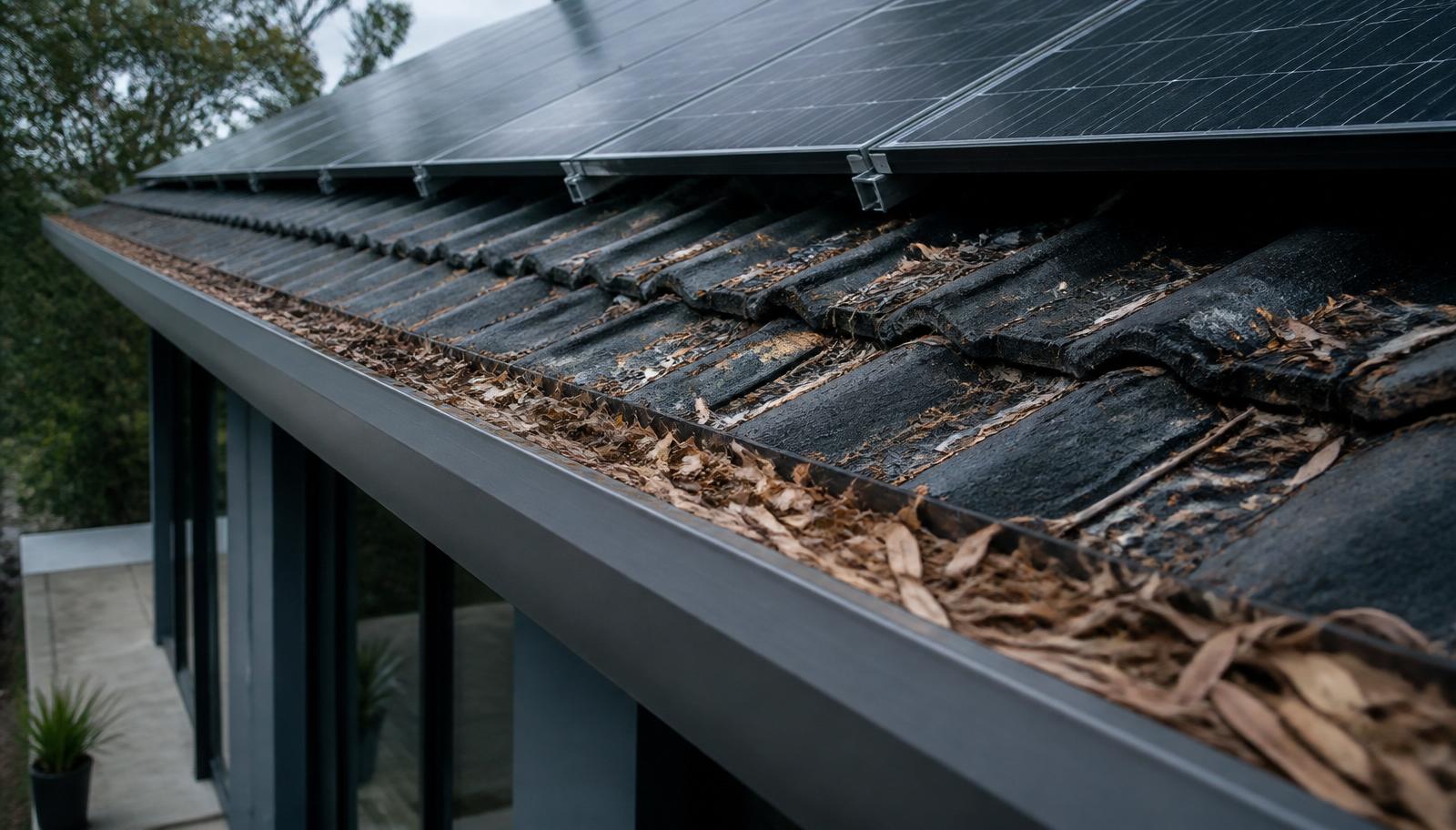
A panel array turns a smooth roof plane into a series of low walls and shaded gaps. Gum leaves, bark strips and jacaranda seed pods that once slid into the gutter and washed through the downpipe now stall under the frames, break down into a wet mulch, then release all at once during the first heavy rain. Your gutter gets the whole load in one hit instead of a trickle across the season.
Late July is the worst point in the Sydney calendar for this. The winter leaf drop is finished, the mulch under the panels has had two months to compost, and the spring storm season starts building through September. This is the short window where a solar roof can be cleared before the water arrives.
What a Panel Array Actually Does to Water Flow
Panels sit on rails, usually between 80mm and 150mm above the roof surface. That gap is the problem and the reason a solar roof behaves nothing like a bare one.
Three things change the moment the array goes up:
- Debris gets trapped instead of shed. The rail feet, the frame edges and the cable trays all catch material that would otherwise travel to the gutter and flush through.
- Water is concentrated. Rain hitting a panel runs off the lower edge in a sheet rather than spreading across the tiles, so it arrives at the gutter faster and in narrower streams.
- The roof stays damp for longer. Shade under the array slows drying, which lets trapped organic matter rot rather than dry out and blow away.
The combined effect is a gutter that fills faster, holds more moisture, and clogs at different points than it did before. Homeowners who cleaned once a year for a decade without trouble suddenly find their gutters overflowing in the second winter after installation, and assume the gutters have failed. The gutters are fine. The catchment above them changed.
Where the blockage forms on a solar roof
On a bare Sydney tiled roof, blockages usually start at the downpipe outlet and work backwards. On a solar roof they start higher and behave differently.
- Directly below the lowest row of panels, where sheet runoff dumps concentrated debris into a short section of trough.
- In the valleys, because material pushed sideways by the frames collects there instead of running straight down.
- At the leading edge of the array itself, where a berm of compacted mulch forms against the bottom rail and holds water on the tiles.
That third one causes the damage people do not see coming. Water held on tiles behind a debris berm finds the laps, tracks under the tile and into the sarking, and shows up months later as a stain on a bedroom ceiling.
Late Winter Is Peak Debris Season in Sydney
Sydney's tree canopy does not behave like the northern hemisphere textbooks. Eucalypts shed bark and leaves through summer and again after dry spells, jacarandas drop through late spring, and the fine needle litter from casuarinas and callistemons falls more or less continuously.
What makes late July different is accumulation rather than fall rate. Bureau of Meteorology records for Sydney show winter as a lower rainfall period than autumn across most of the basin, so there has been less water moving through the system to flush anything out. Material sitting under panels since May has not been washed anywhere. It has just been sitting there getting heavier.
Then the pattern flips. From September the storm frequency climbs, and by November a single afternoon cell can drop 30mm to 50mm in under an hour across the North Shore and the Hills. A gutter that was coping at a slow trickle will not cope with that, and the overflow goes exactly where you do not want it.
What Lives Under a Sydney Solar Array
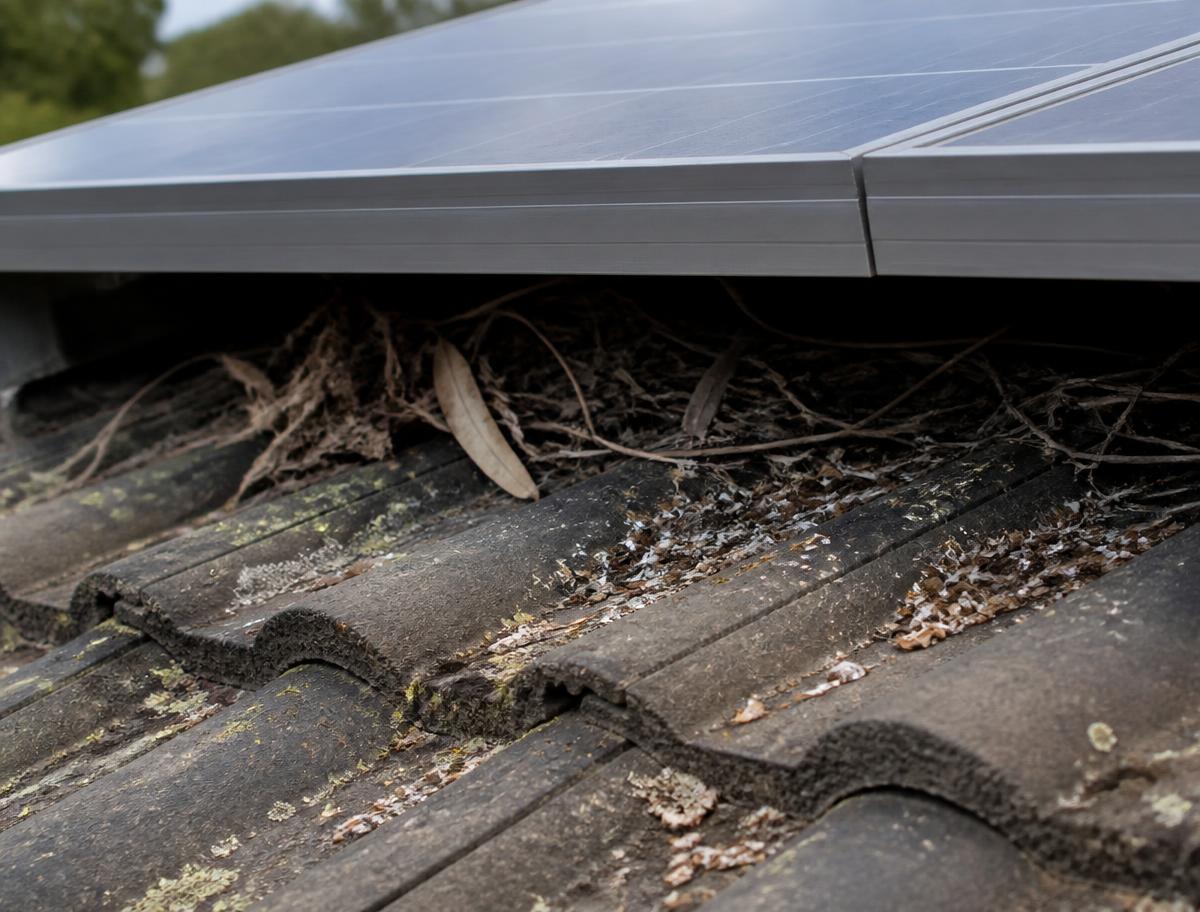
The gap between panel and tile is dry, sheltered, warm and predator free. Every native animal in Sydney has worked this out.
Birds and the August nesting window
Pigeons, mynas and starlings build directly on the tiles under the array, and they build with the same material that blocks gutters: twigs, bark, grass and feathers. Nesting activity ramps up through August and peaks in spring, so a cavity that is clear in July can be fully packed by October.
Sulphur crested cockatoos are the more expensive visitor. They chew, and they chew soft things, which on a solar roof means DC cabling and cable ties. NSW protects native birds under state wildlife law, so the correct approach is exclusion mesh and removal of nesting material outside the breeding period, not interference with an active nest. Information on protected native species is available through NSW Department of Climate Change, Energy, the Environment and Water.
Possums, rodents and the mess they leave
Ringtail possums use the array as a highway between branches and the ridge. Rats follow. What they all leave behind is droppings and nesting debris, and that material washes into the gutter with the first real rain.
There is a hygiene dimension here that matters more than most people realise. If your roof feeds a rainwater tank, contaminated debris entering the gutter goes straight to the tank inlet, which we cover in detail in our guide to rainwater tank contamination from dirty gutters.
The Sydney Water Bill Connection Most Solar Owners Miss
Here is where a roof problem becomes a bill problem, and where a lot of Sydney households get caught.
Sydney Water pricing moved under the IPART determination that took effect from 1 October 2025, with the usage charge continuing to step up across the current price path. That means every kilolitre now costs more than it did when your solar system was installed, and the bill is more sensitive to anything going wrong on the property.
Owners who see a jump often go looking for a leak, find the Hidden Leak Allowance page, and assume they are covered. They are not, and the reason is worth understanding properly.
The Hidden Leak Allowance is designed for concealed leaks on the private side of the meter: a pipe under a slab, a supply line behind a wall, something you could not reasonably have found. It requires a licensed plumber's report, and it only applies once the leak has been repaired. Gutter overflow is not a leak at all. No treated water escapes your pipes, so nothing about the allowance applies.
What gutter overflow does instead is drive water consumption up indirectly:
- Saturated garden beds and lawns get watered anyway, because the damage from waterlogging looks like drought stress to most homeowners.
- A rainwater tank that is not filling properly, because the gutter is diverting flow over the front lip, pushes the household back onto mains supply for toilets and irrigation.
- Damp subfloor and wall cavities lead to more cleaning, more pressure washing and more general water use.
The tank point is the sharpest one for solar households, because the same people who install panels usually install tanks. A blocked gutter above a tank quietly cancels the water saving you paid for, and the mains meter picks up the difference. We break down the full billing picture in our article on why blocked gutters inflate Sydney water bills, and the current price path is published by IPART.
What Debris Costs Your Solar Output
Panel soiling is well documented. Dust, salt film, bird droppings and shading from accumulated litter along the bottom edge of a panel all reduce output, and the losses are not trivial on a dirty Sydney roof after a dry winter.
Two effects matter:
- Surface soiling. A uniform film of dust and pollen reduces the light reaching the cells. It clears partially with rain, though not on low pitch roofs where water pools rather than sheets off.
- Partial shading. This is the expensive one. A strip of leaf litter across the bottom edge of a panel can drag down the output of an entire string on older string inverter systems, because the weakest cell sets the limit.
The Clean Energy Council publishes guidance on system ownership and maintenance for Australian households, and accredited installer information is available through the Clean Energy Regulator. Both make the same basic point: a system is an asset with a maintenance schedule, not a set and forget appliance.
There is a warranty angle too. Some installation warranties require the array and its surrounds to be kept reasonably clear, and corrosion damage traced to standing organic matter against the mounting feet is a common exclusion. Rotting leaf mulch holds moisture directly against aluminium rails and roof penetrations, which is exactly the environment that starts galvanic corrosion on a coastal Sydney roof. Our piece on salt air gutter corrosion explains why eastern suburbs and northern beaches homes see this faster.
Ember Risk Under a Panel Array
Sydney's bush fire danger period begins on 1 October across most of the Greater Sydney area, and homes in Hornsby, Ku-ring-gai, the Hills and the western fringe sit against or inside bushland.
A panel array creates a sheltered pocket of dry fine fuel that sits above the roof line and below the panel. Embers land, funnel under the frame, and find fuel that no gutter guard is protecting because it is not in the gutter. The NSW Rural Fire Service guidance on building in bush fire prone areas treats roof gaps and accumulated debris as a primary ignition path, and a solar array manufactures exactly that geometry.
Practical steps for a bush fire prone Sydney property:
- Clear under panel cavities before 1 October, not after the first fire weather warning.
- Fit ember guard mesh around the array perimeter if the property is BAL rated.
- Keep the gutter itself empty through the danger period, since a full gutter is still the number one ignition point on an Australian house.
We go further into this in our guide on why blocked gutters ignite first in a Sydney bushfire.
How to Clean Gutters on a Solar Roof Without Wrecking Anything
This is not the same job as clearing a bare roof, and the difference is why a lot of general cleaners will not touch a solar property.
What has to change:
- No walking on panels, ever. Micro cracks in cells are invisible and permanent, and they show up months later as a dead string in the monitoring app.
- No high pressure water near the array. Pressure forces water past panel seals and into junction boxes and connectors.
- No metal tools near DC cabling. A solar array is live in daylight and cannot be switched off at the panel.
- Vacuum extraction rather than scooping on a tight roof, because there is no clear tile space to place a bucket or kneel on.
Our own approach on a solar property is a ground based vacuum system where the roof is accessible from the perimeter, and a harnessed roof access job where it is not. We photograph the array perimeter before and after so you have a dated record of the debris load, which matters if you ever need to demonstrate maintenance to an insurer. See gutter vacuuming for how the extraction method works, or gutter cleaning for the standard service.
What we do not recommend you do yourself
Ladder falls are the most common serious home maintenance injury in Australia, and a solar roof adds live electrical equipment to the hazard list. SafeWork NSW treats any work above two metres as a fall risk requiring controls, and a two storey Sydney roofline is well past that.
If you are weighing it up, read our honest breakdown of the ladder risk in DIY gutter cleaning first.
Gutter Guard on a Solar Roof: What Actually Works
Gutter guard is a better investment on a solar roof than on a bare one, because you cannot easily inspect what you cannot see, and access costs more every time.
What works well:
- Aluminium mesh with a fine aperture, fitted to run under the first row of tiles and over the gutter lip, so debris sheds past the front edge rather than sitting on top.
- Ember rated mesh on any property in a bush fire prone area, since it addresses two problems with one product.
- A separate panel perimeter mesh, which is a different product to gutter guard and closes the panel to tile cavity against birds and possums.
What does not work:
- Plastic mesh, which becomes brittle in Sydney UV within a few summers and then fragments into the gutter.
- Foam inserts, which hold moisture and organic matter against the gutter base and accelerate rust.
- Any guard installed without checking the roof fall first, because a guard on a sagging gutter just relocates the overflow point.
Pricing and product comparison sit in our gutter guard guide for Sydney homes, and the installation service is at gutter guard installation.
Your Late Winter Solar Roof Checklist
Work through this before the September storms.
- Open your monitoring app and compare this July against last July. A drop of more than five to eight per cent with no equipment fault usually points at soiling or shading.
- Stand at ground level with binoculars and look along the bottom edge of the array for a visible mulch berm.
- Check the gutter line directly under the panels for sagging, which indicates a sustained wet load.
- Look for overflow staining on the wall below panel edge gutters, not just below the downpipes.
- Check whether your downpipe discharges into the stormwater connection or onto soil beside the footings.
- If you have a rainwater tank, inspect the first flush diverter and the inlet screen for organic sludge.
- Book the clear before the end of August, because September to November is the busiest run of the year and access windows tighten.
Get the Array Perimeter Cleared Before the Storms Arrive
A solar system is usually the largest single upgrade a Sydney household makes to its roof, and it quietly increases the maintenance requirement of everything around it. The panels are still doing their job. The roof underneath them is the part that needs attention now, while the weather is dry and the nesting season has not peaked.
GutterFlow Solutions works on solar equipped roofs across Sydney, the Central Coast, Newcastle and the Hunter, using vacuum extraction and harnessed access rather than pressure washing anywhere near an array. Every job includes downpipe flushing, before and after photographs and a written note on anything we find under the panel line.
Call 0468 057 750 or request a quote and we will get you booked before the spring run.
Need Your Gutters Cleaned?
GutterFlow Solutions provides fast, professional gutter cleaning across Sydney, Central Coast, Newcastle & the Hunter Region.