Sydney Nesting Season: Birds, Gutters and Spring Damage
Why August Is the Month Birds Move Into Your Gutters
Walk down any street in Willoughby or Woy Woy in the second week of August and you will hear it before you see it. Magpies working the verge, Indian mynas arguing on a ridge cap, and a steady traffic of twigs and dry grass heading up to roof level. Nesting season across the Sydney basin runs from late winter through to about December, and it peaks right now.
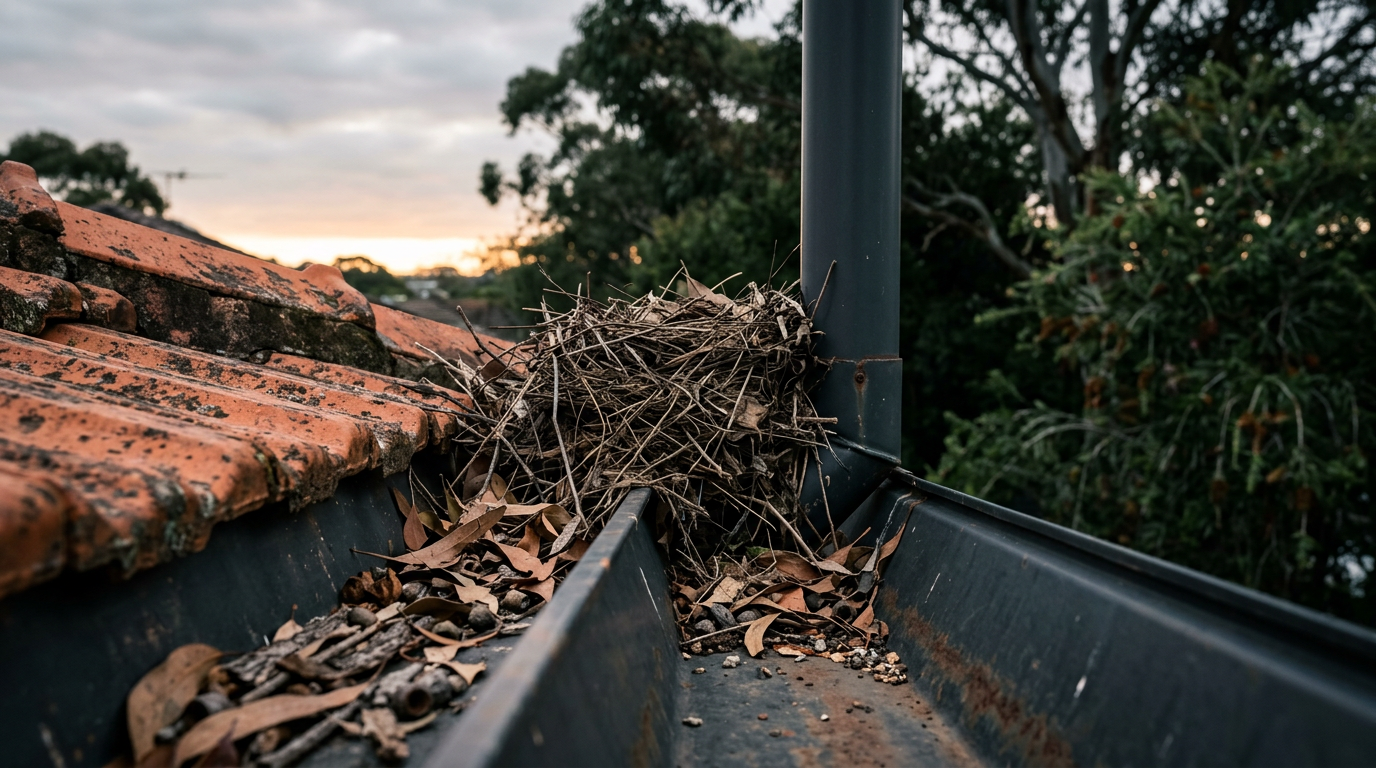
A gutter is close to perfect for a nesting bird. It is off the ground, sheltered by the eave, warm against a north-facing wall, and already lined with the exact material a bird would otherwise spend a week collecting. Most homeowners never look, because the trough sits above eye level and the nest is silent by the time the rain matters.
The problem is timing. A nest built in August sits in the gutter through September and October, which is when Sydney's spring storm pattern arrives. By the time water is pouring over the fascia at the back of the house, the blockage has been building for two months and the timber underneath has been wet the whole time.
What a Nest Actually Does to a Gutter Run
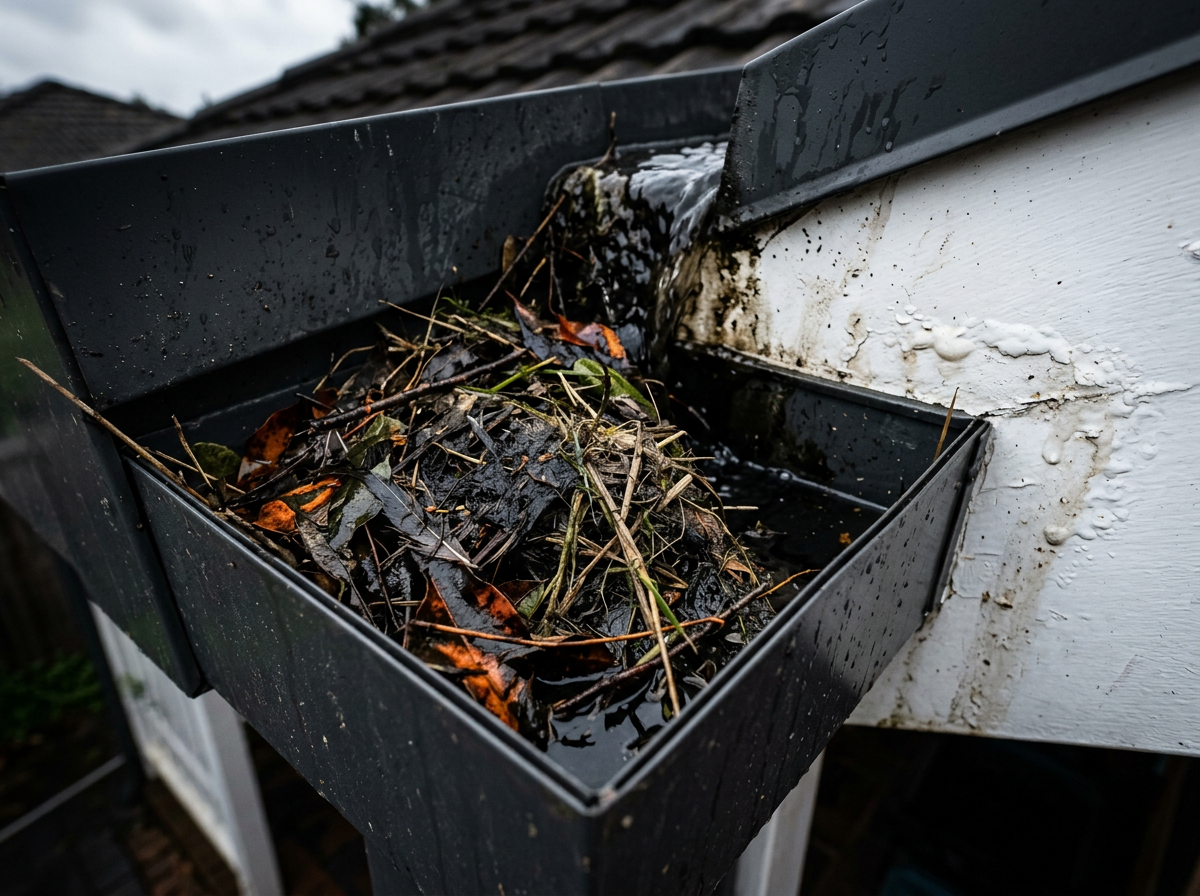
A leaf blockage is loose and porous. Water finds a path through it eventually, which is why a leaf-choked gutter still drains slowly after the rain stops.
A nest behaves nothing like that. It is woven, compacted, and often bound with mud, plastic and fibre. Drop it against a downpipe outlet and you have a proper dam, not a filter. The trough fills to the brim in the first ten minutes of a storm, then overflows at the weakest point.
On most Sydney homes the weakest point is the back edge, not the front. Water rises above the rear lip, runs behind the fascia, and enters the eaves cavity. That is the failure path behind almost every late-spring ceiling stain we get called to, and it is covered in detail in our guide to Sydney roof leaks caused by gutters.
There is a second effect that is easy to miss. Nesting material travels. Loose twigs and grass wash down the run and into the downpipe, where they wedge at the first bend or at the stormwater connection underground. You clear the visible nest, the gutter drains fine, and the blockage has simply moved somewhere you cannot see.
The Birds Sydney Homeowners Deal With Most
Different species cause different problems, and the fix is not the same for each.
Indian Mynas
Mynas are the ones that turn a gutter into a rubbish tip. They nest in cavities and stuff the space with grass, feathers, plastic bags and food waste, and they will happily use a box gutter, a valley, or the gap where a downpipe meets a wall bracket. They are an introduced species and are not protected, which changes what you are allowed to do about them.
Pigeons
Pigeons prefer the flat spots: box gutters on inner-west terraces, parapet gutters on shopfronts along Parramatta Road, and the sheltered trough behind a mansard. Their nests are messier than they are big, and the droppings that build up alongside them are the real issue for anyone collecting rainwater.
Noisy Miners and Magpies
Native birds usually nest in trees rather than in the gutter itself, but they use the roof as a staging platform and drop material into the trough constantly through August and September. Magpies also become territorial around the nest tree, which is a practical reason to get roof work done early rather than during swooping season. Both species are protected under NSW law.
Welcome Swallows and Sparrows
Swallows build mud cups under eaves and against fascia boards, directly above the gutter line. The nest itself rarely blocks the trough, but the mud and droppings that fall from it sit in the gutter and set hard. Sparrows work their way into the gap between a tiled roof and the gutter and build back under the tiles where nothing is visible from the ground.
The Law: You Cannot Simply Pull an Active Nest Out
This is the part most homeowners get wrong, and it matters because the penalties are real.
Native birds and their nests are protected in New South Wales under the Biodiversity Conservation Act 2016. If a magpie, miner, wattlebird or swallow has an active nest with eggs or chicks in it, you cannot legally remove or destroy it, and neither can a contractor working on your roof. The NSW government's guidance on protected native animals sets out what is allowed and who to call when wildlife is involved.
Introduced species sit in a different category. Common mynas, feral pigeons and house sparrows are not protected, so their nests can be removed at any stage. Telling them apart is not always obvious from the ground, and the Australian Museum's bird identification resources are the fastest way to work out what you are looking at before anyone climbs a ladder.
Our practical rule is straightforward. If the nest is empty, we remove it and bird-proof the run the same visit. If it is active and the species is protected, we clear everything around it, restore flow through the downpipe, note the location, and come back once the chicks have fledged. Nobody wants a fine attached to a gutter clean.
That is also the strongest argument for booking early. A nest that has not been built yet raises no legal question at all.
The Water Bill Angle: Sydney Water Prices and the Hidden Leak Allowance
Sydney Water lifted its prices from October 2025, and the schedule published in its pricing information means every litre that leaves your property without doing anything useful now costs more than it did two years ago. Households on the Central Coast face the same pressure through their own utility.
Here is where nesting blockages catch people out. Sydney Water offers a hidden leak allowance that can credit part of a bill when a concealed pipe leak inflates your usage. It is designed for underground and in-wall failures that a homeowner could not reasonably have found.
A blocked gutter does not qualify. Nothing about a nest dam registers on your water meter, because the water involved is rainwater, not mains supply. What it does instead is knock out the free supply you were relying on. Every home with a tank connected to a nest-blocked downpipe quietly switches back to paid mains water, and the change shows up as a higher bill with no obvious cause.
The second cost is worse. Overflow that soaks a garden bed, a lawn or a subfloor pushes homeowners into running mains irrigation to fix drainage-related plant stress in summer, while the actual fault sits three metres above their heads. Fixing the gutter is the cheapest water-saving job on the property.
What Nest Blockage Costs When You Leave It Until Summer
The repair sequence is predictable, and the numbers climb fast:
- A clean in August: typically 250 to 450 dollars for a standard single-storey Sydney home, and the job is done in a morning.
- Fascia and eave repainting after one wet spring: 800 to 2,000 dollars once blistered paint and swollen timber need preparation.
- Fascia board replacement: 90 to 160 dollars per metre for supply and install once rot has taken hold behind the gutter.
- Ceiling sheet replacement after a cavity leak: 1,500 dollars and up for one room, plus paint.
- Blocked stormwater line jetting: 400 to 900 dollars when nesting material has travelled down the downpipe into the underground run.
- Rainwater tank flush and disinfection: 300 dollars and up when droppings and decayed material contaminate the stored supply.
The pattern is consistent. Every job on that list starts as a 300 dollar clean and becomes a four-figure repair somewhere between the first spring storm and the January downpours. Our breakdown of what gutter cleaning should cost in Sydney sets out where the pricing bands sit.
The Pre-Spring Clean: What a Proper Job Includes
Clearing a nest is not the same as clearing leaves, and a rushed job leaves the blockage in the system. This is the sequence that works:
- Inspect before touching anything. Identify whether nests are present, whether they are active, and what species built them.
- Clear the trough by hand or vacuum. Gutter vacuuming removes compacted nesting material and wet sludge without pushing it toward the outlet, which is what a blower does.
- Pull and flush every downpipe. Nesting fibre wedges at the first bend, so each downpipe needs testing with water rather than a visual check.
- Clear valleys and box gutters separately. These hold the most material and are the hardest to see from the ground.
- Check the back edge and fascia line. Soft timber, blistered paint or rust streaks tell you overflow has already happened at least once.
- Fit outlet guards and bird-proofing. Downpipe grates and mesh at the outlet stop the next nest from reaching the stormwater line.
- Photograph the finished run. Dated images matter for insurance and for the maintenance record strata committees and insurers ask for.
Anyone considering doing this themselves should read the SafeWork NSW guidance on working at heights first. Ladder falls at gutter height are among the most common serious home injuries in New South Wales, and a startled bird at close range is a genuine hazard on a ladder.
How to Stop Birds Nesting in Gutters for Good
Cleaning solves this year. Bird-proofing solves the next five:
- Fit quality gutter guard. A rigid aluminium or steel mesh across the trough removes the nesting cavity entirely, which is the only permanent answer. Our gutter guard installation page covers mesh types and current Sydney pricing.
- Cap and mesh downpipe outlets. Outlet guards keep travelled material out of the underground stormwater line even when debris gets into the trough.
- Block roof-to-gutter gaps. Sparrows and starlings get under tiles at the roof edge, and edge-sealing strips close that entry point.
- Screen valley gutters. Valley mesh stops nesting material from washing sideways under the tiles.
- Trim overhanging branches back two to three metres. Less canopy contact means fewer staging perches directly above the roofline.
- Keep the trough sound. Rust holes and sagging runs hold standing water, and standing water attracts both birds and mosquitoes. Gutter repairs are cheaper before the base perforates.
Gutter guard carries a second benefit that matters in Sydney specifically. The same mesh that keeps a myna out keeps embers out, which is why we recommend it for anyone in a bushfire prone area on the urban fringe. Our bushfire and ember risk guide explains how that works ahead of the October danger period.
The Health Risks Most People Never Consider
Bird material in a gutter is not just a drainage issue.
Dried droppings mixed with nesting debris can carry psittacosis, a bacterial infection that people pick up by breathing dust from contaminated material. NSW Health publishes a psittacosis factsheet that explains the transmission route and why dry-sweeping bird waste is the worst way to handle it.
Then there is what happens indoors. Overflow behind a fascia wets the top plate and the ceiling insulation, and once that stays damp for a few weeks you get mould growth in the roof cavity. The NSW Health mould factsheet links persistent indoor damp to respiratory symptoms, and the source is often a gutter nobody has looked at.
Standing water in a dammed gutter also breeds mosquitoes through the warmer months, which is a nuisance in Sydney and a real concern on the Central Coast where arbovirus surveillance runs every summer.
Anyone drinking tank water has a further reason to act. Nesting material and droppings sitting above the tank inlet contaminate the stored supply, and our guide to rainwater tank contamination from dirty gutters covers the first-flush and screening requirements that keep it drinkable.
What to Check From the Ground This Weekend
You do not need a ladder to work out whether something has moved in. Ten minutes with a pair of binoculars from the back lawn will tell you most of what a roof plumber would find.
- Watch the roofline at dawn. Birds carrying material fly the same route repeatedly, and the spot they land on is the spot to inspect.
- Look for bulk above the gutter lip. A twig nest usually sits proud of the trough, so you can see it as a lump breaking the straight line of the gutter.
- Check the ground under each downpipe. Grass, twigs or feathers washed onto the path mean material is already moving through the system.
- Look at the fascia paint. Vertical dark streaks or blistering below the gutter line means the run has overflowed at the back at least once.
- Listen in the eaves. Scratching or chirping inside the roof edge means birds have gone past the gutter and under the tiles, which is a different repair.
- Run a hose into the gutter on a dry day. If water pools rather than moving toward the outlet, something is holding it back.
If any of those show up, get the run cleared before the next front comes through rather than after. The difference between a booking made in August and one made after the first big spring storm is usually the difference between a clean and a repair.
Compliance: The Standard Behind All of This
Roof drainage in Australia is governed by AS/NZS 3500.3, the plumbing and drainage standard that sets gutter capacity, fall, overflow provision and downpipe sizing. You can view the current edition through the Standards Australia catalogue.
The standard assumes a clear waterway. A gutter sized correctly for a one-in-twenty-year storm event fails at a fraction of that intensity once a nest reduces the cross-section. Compliance at installation means nothing without maintenance behind it, which is the point insurers make when they decline a storm claim, as covered in our storm insurance claim guide.
For anyone sizing or replacing a system, the same standard drives downpipe count and diameter. Our downpipe sizing guide translates the tables into practical numbers for Sydney roof areas.
Book the Clean Before the Nests Are Built
The window is short and it is open now. Every week through August and September, more nests get built and more of them become legally untouchable until the chicks have gone. A clean this month is a straightforward job. The same clean in November is a negotiation with a protected species and a repair quote for whatever the overflow has already done.
If you have not had your gutters cleared since autumn, book a professional gutter clean now and get the run bird-proofed while it is empty. We work across Sydney, the Central Coast, Newcastle and the Hunter, and we photograph every job so you have the maintenance record if you ever need it.
Call GutterFlow Solutions on 0468 057 750 or request a free quote and we will get you booked before spring rain arrives.
Need Your Gutters Cleaned?
GutterFlow Solutions provides fast, professional gutter cleaning across Sydney, Central Coast, Newcastle & the Hunter Region.