
Sydney Rainwater Tank Contamination: The Dirty Gutter Problem
Why Sydney Tanks Look Worst in June
Walk down any street in Hornsby, Lane Cove, the Northern Beaches or the Sutherland Shire in early June and you will see them. Slimline tanks tucked against weatherboard walls, round poly tanks behind sandstone retaining walls, twin connected tanks under federation eaves. Most of them were installed during the Millennium Drought, came back into fashion after the 2019 to 2020 bushfire summer, and have quietly been collecting whatever the gutters above them deliver ever since.
June is the month the problem becomes visible. The autumn leaf drop from liquidambars, plane trees and the deciduous suburbs along the North Shore has just finished. The eucalyptus and gum bark drop is ongoing all year. The first proper East Coast Lows arrive, the gutters that looked fine in March are now packed solid, and the water that finally reaches the tank inlet is dark, smelly and full of suspended solids.
If your tank water has shifted from clear to amber, or from amber to brown over the past six weeks, the rain did not cause that. The rain only revealed what your gutters have been holding back.
What Is Actually In That Dark Water
The water sitting in a neglected Sydney tank right now is not just leaf-stained. NSW Health and enHealth have both published guidance on rainwater quality, and the recurring contaminants in roof-collected water are well documented. There are four worth understanding, because each one points back to a specific gutter problem.
Eucalyptus and Paperbark Tannins
Australian native trees shed leaves, bark and oil-rich debris year-round. When that material sits in a wet gutter for weeks, the tannins leach out and travel into the tank with the next downpour. Tannins are not directly dangerous to drink, but they discolour the water, stain laundry, and feed bacterial growth at the tank base. Inner West and Lower North Shore homes under mature gum canopy are the worst affected.
Bird and Possum Droppings
A clean gutter sheds bird droppings with the first rain. A blocked gutter holds them in standing water for weeks, where the bacteria multiply. The most studied pathogens in roof-collected rainwater are Campylobacter, Salmonella and Cryptosporidium, all linked to bird droppings. The risk is low if the tank is well managed. It rises sharply when the gutter is the buffer.
Roof Dust, Pollen and Atmospheric Fallout
Sydney sits between an industrial corridor in the west, the Pacific in the east, and increasingly long bushfire smoke seasons in spring and summer. Everything that lands on a Colorbond or tile roof eventually washes into the gutter. From there it either flushes out the downpipe with a first flush diverter, or settles in the tank as sediment.
Biofilm
This is the one most homeowners have never heard of. Inside a gutter that holds organic matter and standing water, a slippery film of bacteria, fungi and algae forms on the metal surface. A finger run along the inside of a neglected gutter comes out coated in dark green-brown slime. That biofilm continually sloughs off into the tank, where it seeds new biofilm growth on the tank walls.
The Sydney Water Price Rise Changes the Maths
From 1 July 2025, Sydney Water's IPART-approved price determination took effect. The typical residential bill rose by about 18 percent in the first year, with further increases scheduled annually through to 2030. For a four-person Sydney household, that is roughly $250 to $400 more per year on water alone, before any usage spike from a hidden leak.
That shift is the reason interest in rainwater tanks is climbing again across Sydney. A 5,000 litre tank plumbed to laundry, toilet and garden can realistically cover 30 to 50 percent of household water use in the average wet Sydney winter. The economics that did not quite work in 2018 absolutely work in 2026.
There is one condition. The tank has to actually deliver clean water. A contaminated tank means you stop using it for laundry because it stains, stop using it for toilet flushing because the pump keeps clogging, and end up paying full price for mains anyway. The Sydney Water price rise only rewards homes whose gutters are doing their job.
The Hidden Leak Allowance Trap Around Tanks
This needs to be said clearly because the confusion is constant. Sydney Water's Hidden Leak Allowance covers concealed leaks on the pressurised mains supply inside your property boundary, confirmed by a licensed plumber. It does not cover anything to do with your rainwater tank.
If your tank pump fails and floods the side passage, that is not covered. If your tank overflow blocks and water tracks back into your soffit, that is not covered. If contaminated tank water damages your washing machine, that is between you and your contents insurer. Tank systems sit outside the Sydney Water network entirely.
The practical takeaway is that prevention sits with the homeowner. There is no government scheme that bails you out when a neglected gutter contaminates a tank.
How Dirty Gutters Move Contamination Into the Tank
This is the part most homeowners have never had explained properly. The journey from leaf in the gutter to dark water in the kitchen tap follows a predictable path.
- Organic debris collects in the gutter through autumn and winter.
- Standing water sits behind the blockage and starts breaking the debris down.
- The next rain event pushes a concentrated slug of dissolved tannins, bacteria and sediment down the downpipe.
- If the first flush diverter is undersized, full, or missing, that slug goes straight into the tank.
- The heaviest sediment settles at the tank base and starts a sludge layer.
- The dissolved organics feed bacterial growth in the water column above.
- The biofilm on the tank walls thickens, releasing more bacteria back into the water.
- The household tap draws from the middle of the tank, where the water now carries everything from steps two through seven.
Breaking that chain at step one is by far the cheapest intervention. Every step after step one costs more time and money to fix.
What a Proper Sydney Tank-Feed Gutter Clean Includes
A gutter clean for a property with a rainwater tank is not the same job as a gutter clean for a property on mains only. The standard for tank-feed properties is higher because the consequences of cutting corners end up in your drinking water. A correct clean covers six things.
- Full removal of all leaf, bark, twig and sediment debris from every gutter run, not just the ones easy to reach.
- Flushing of every downpipe with clean water to dislodge sediment caked inside the pipe walls.
- Inspection and clean-out of every first flush diverter chamber, including emptying the trapped first-flush water.
- Removal, rinsing and refitting of every tank inlet leaf screen and overflow screen, with replacement of any damaged mesh.
- Visual inspection of the roof catchment for overhanging branches, moss build-up and any rust spots that may be shedding into the gutter.
- A short written report noting the state of the gutter system, the diverter, the tank inlet and any recommended follow-up.
If you are paying for a gutter clean on a tank-fed property and the technician is not opening the first flush diverter, the job is not finished.
The Seasonal Maintenance Calendar That Actually Works in Sydney
The wrong instinct is to clean gutters after the visible mess. By then the contamination is already in the tank. The right rhythm for Sydney tank owners is preventative and tied to the local canopy.
- Late autumn, May to early June: clean before the East Coast Low season. This is the single most important clean of the year for tank water quality.
- Early summer, late November to early December: clean after the spring gum and jacaranda drop and before the bushfire and storm season.
- Annual: check the first flush diverter outlet valve actually drains and is not blocked with sediment.
- Every two to three years: professional internal tank inspection and external-vacuum de-sludge, in line with enHealth guidance.
Homes under heavy eucalyptus, paperbark or pine canopy almost always need a third clean in late winter. Coastal homes from the Northern Beaches down through Cronulla also benefit from a salt-related inspection in late summer.
Five Signs Your Tank Is Already Compromised
Most contamination is invisible until it is not. These five signs mean the tank water has already moved past the point where a gutter clean alone will fix it.
- Visible amber, brown or tea-coloured water at the tap or in a clear glass.
- A musty, earthy or rotten-egg smell from a tap that has been flushed for ten seconds.
- Persistent yellow or grey staining in toilet bowls or on laundry whites.
- A slimy feel on the inside of the tank inlet or overflow screens.
- Pump short-cycling, filter blockages or unusually frequent cartridge changes.
If you are seeing any of these, the gutter clean still matters, but it needs to be paired with a tank de-sludge before the next heavy rain event refills the contamination.
What Healthy Tank Water Should Look Like
Healthy tank water in Sydney should be clear, odourless when poured into a glass, and free of any visible particulate matter. There may be a very faint mineral taste depending on the roof material. There should never be a colour, a smell or a film at the surface. If the water from your tank looks indistinguishable from mains water, your gutter and roof catchment is doing its job.
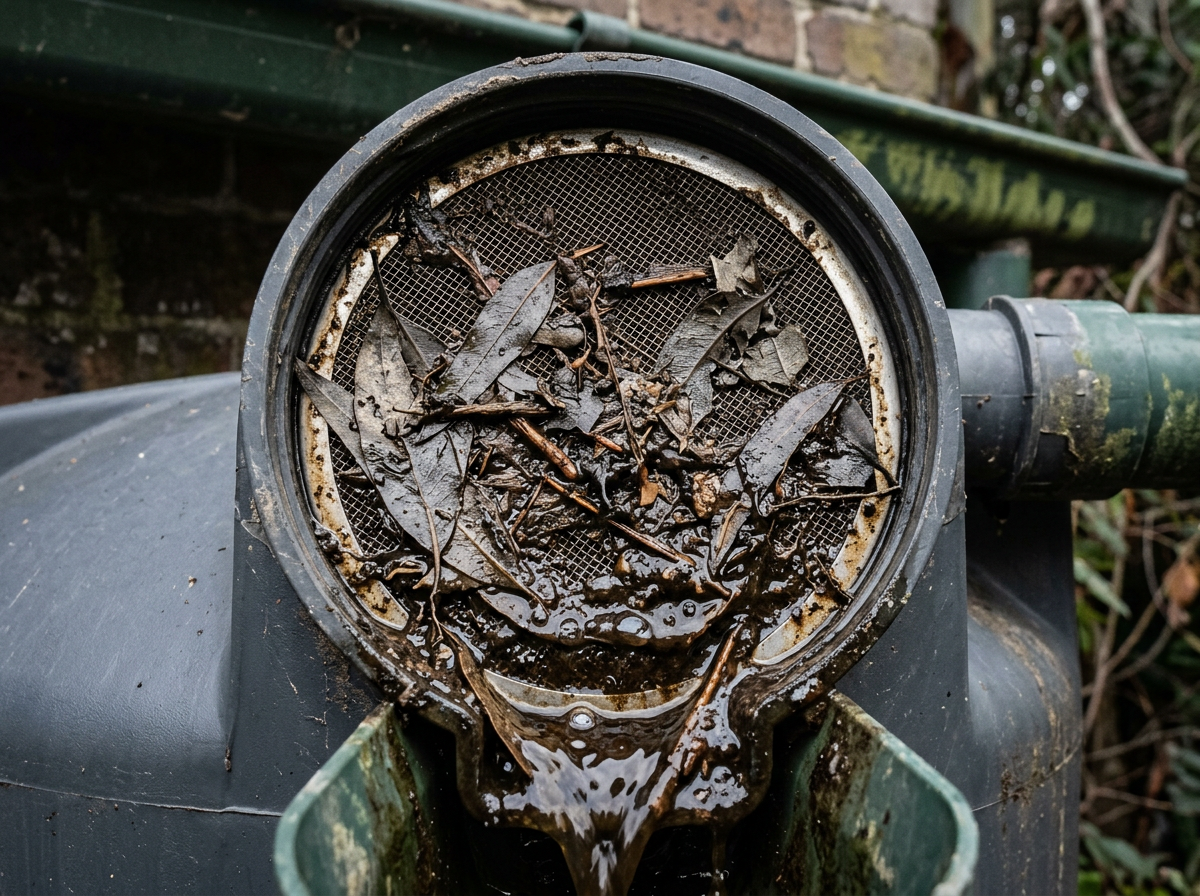
The image below shows what most Sydney tank inlets actually look like in winter. The leaf screen has caught a wet mat of eucalyptus leaves, the rim is coated in dark biofilm, and the first flush diverter behind it has overflowed. Every drop of rain landing on this roof is now bypassing the protection that was installed for exactly this scenario.
Compliance Notes for NSW Homeowners
A few quick references for the people who want the underlying standards behind tank-fed gutter maintenance in NSW:
- AS/NZS 3500.3 covers stormwater drainage and includes the relevant provisions for rainwater catchment from roofs.
- enHealth Guidance on Use of Rainwater Tanks is the federal reference document published by the Australian Government Department of Health.
- NSW Health Rainwater Tanks guidance is the state-level fact sheet covering water quality, maintenance and treatment.
- NSW Fair Trading covers consumer protection for tank and pump installations carried out by licensed tradespeople.
None of these documents are difficult to read, and all of them point back to the same conclusion. The gutter is the single most important variable in tank water quality.
When To Call a Professional
There are three situations where a DIY clean is the wrong call on a tank-fed Sydney home. The first is any property over a single storey, where a fall from height risk outweighs any cost saving. The second is any property where the tank inlet, first flush diverter or downpipe needs to be opened, because incorrect refitting causes ongoing contamination. The third is any property where the tank water already shows the warning signs above, because cleaning the gutter without cleaning the tank just resets the contamination cycle.
For everything else, the right partner is a licensed gutter and roof plumbing service that understands tank-fed systems specifically, not a general handyman doing gutters on the side.
Protect Your Tank Before the Next East Coast Low
The Bureau of Meteorology's outlook for the rest of winter 2026 points to above-average rainfall along the NSW coast through July and August. Every one of those rain events is an opportunity to refill your tank with the cleanest water it has held all year, or to lock in another season of contamination. The difference between the two outcomes is a single gutter visit booked in the next two weeks.
GutterFlow Solutions services Sydney, the Central Coast, Newcastle and the Hunter Region. Every tank-feed clean includes the gutters, the downpipes, the first flush diverter, the inlet screens and a short written report of what we found. We do not enter tanks. For internal tank de-sludging we refer to specialist confined-space operators.
📞 Call us on 0468 057 750 for a tank-feed gutter clean, or request a quote online. For ongoing protection see our gutter guard installation service and our standard gutter cleaning service. If your roof or gutters are showing rust or sagging that is shedding into the tank, start with our gutter repairs page. Homeowners weighing up a full system upgrade can read our gutter installation guide, and properties with multi-storey or hard-to-reach tank feeds should look at gutter vacuuming.
For the underlying NSW guidance referenced throughout this article, see the NSW Health rainwater tanks page, the federal enHealth Guidance on the Use of Rainwater Tanks, the Sydney Water 2025–30 price determination, the IPART water price decisions, Standards Australia AS/NZS 3500.3 and the Bureau of Meteorology long-range forecast.
Need Your Gutters Cleaned?
GutterFlow Solutions provides fast, professional gutter cleaning across Sydney, Central Coast, Newcastle & the Hunter Region.