Sydney Blocked Stormwater Drains: The Hidden Half
The Puddle That Is Still There Four Days Later
A homeowner in Hunters Hill called us in the third week of August about a patch of lawn beside her back step that had not dried out since the last rain band came through. The gutters had been cleaned in June. The downpipes ran clear. Water still pooled against the paving, and the smell coming off it was closer to a compost heap than a garden bed.
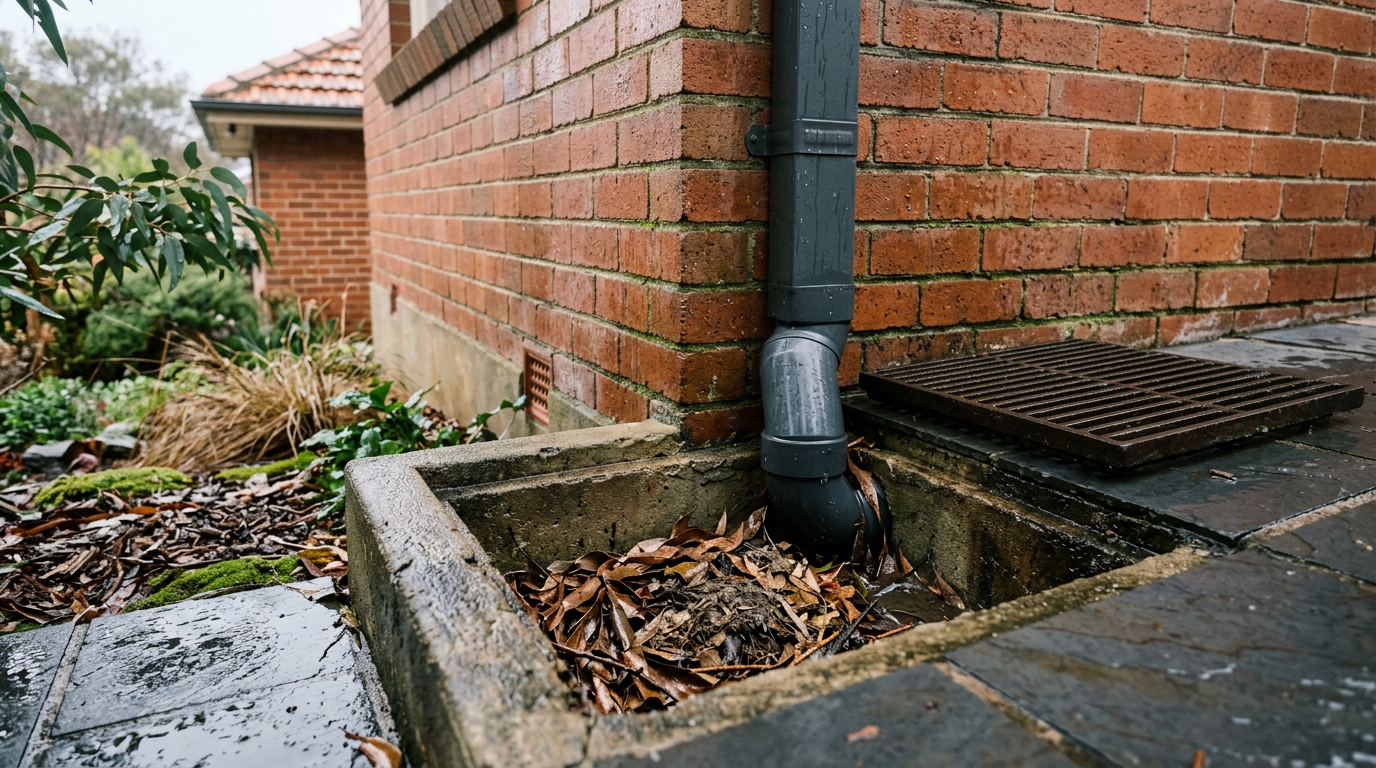
We lifted the grate on the stormwater pit at the corner of the house. Forty centimetres of black silt, gum leaves and jacaranda seed pods, packed so hard it held the shape of the shovel. The buried line running to the kerb had roughly a third of its bore left. Her roof drainage had been working perfectly right up to the point where it disappeared underground, and that is where it had been failing for years.
This is the half of the system almost nobody inspects. A blocked stormwater drain does not announce itself the way a full gutter does. There is no visible sheet of water off the eaves, no obvious mess to point at from the driveway. It shows up as damp brickwork, a lawn that never firms up, and a slow rise in the cost of everything sitting downstream of it.
Where Your Downpipe Water Actually Goes
Roof drainage on a Sydney home is a chain with four links, and most people only ever think about the first one.
- The gutter collects water off the roof plane and moves it along a shallow fall.
- The downpipe takes it vertically to ground level.
- The stormwater pit receives it, catches heavy grit, and hands it to a buried pipe.
- The buried line carries it to the kerb, an inter-allotment easement, an absorption trench or a tank.
Each link is only as good as the one after it. Clearing a gutter while the pit below is choked simply delivers clean water faster to a bottleneck. That is why a house can be cleaned twice a year and still push water back against the wall during a heavy burst.
The design intent behind the whole chain sits in AS/NZS 3500.3, the plumbing and drainage standard referenced through the Plumbing Code of Australia published by the Australian Building Codes Board. The standard gives the system a rated capacity for a given roof area and rainfall intensity. It assumes the pipe is clear. Take a third of the bore away with silt and the house is running on a drainage system it was never approved with.
Why Buried Lines Fail Faster in Sydney Than People Expect
- Root intrusion. Camphor laurels, figs and liquidambars send fine roots through any joint that weeps, then thicken inside the pipe.
- Old earthenware. Inner west and lower north shore homes built before the 1970s often still run on clay pipe with mortared joints that have opened up.
- Silt load. Roof grit, decomposed leaf litter and mortar dust settle in the pit and creep down the line every time flow drops off.
- Flat falls. Long runs on level blocks in Ryde, Epping and Woy Woy hold water between storms, and standing water is where silt hardens.
- Crushed sections. Driveway upgrades, pergola footings and pool excavations regularly clip a stormwater line nobody had marked.
The Five Signs Sydney Homeowners Miss
By the time water is inside a house, the drainage has usually been marginal for two or three seasons. These are the earlier signals.
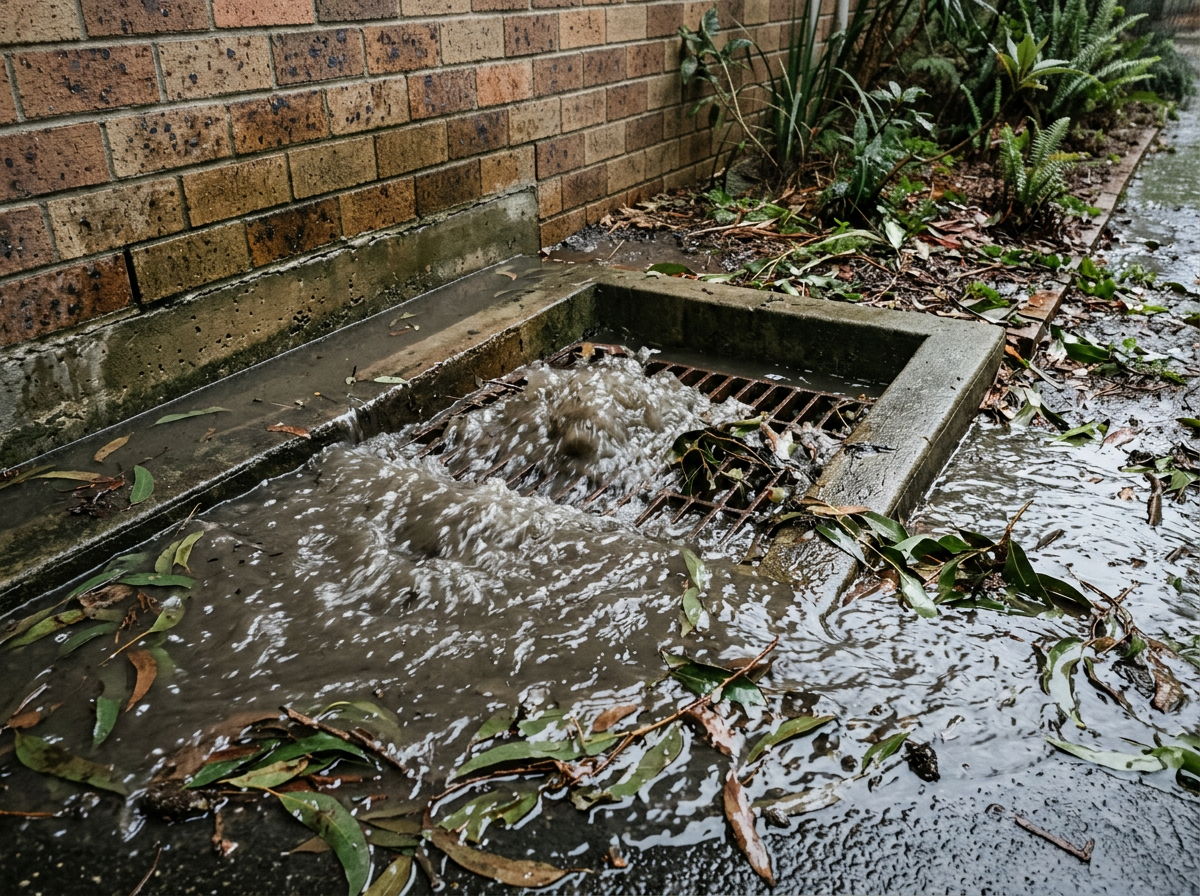
- Water surcharges out of the pit during rain. If the grate bubbles or the pit fills faster than it empties, the outlet is restricted.
- A puddle that outlives the weather. Ground beside a downpipe that stays soft three or four days after rain is being fed from below, not above.
- Gurgling or a hollow knock in the downpipe. Air is being forced back up a partly submerged line.
- Damp brick courses or rising salt. Repeated saturation at the slab edge pushes moisture into the wall and leaves a white bloom.
- Moss, mould or a sour smell near the pit. Organic silt sitting in permanent water produces both.
Any two of those together are worth a look before spring. A single symptom in isolation can be a garden bed problem. Two or more usually is not.
Sydney Water's Price Rise Is the Reason This Matters Now
Here is the part that changes the maths for 2026. Sydney Water's charges have stepped up under the current price determination, and the increase is not only in the usage rate. Fixed service charges have moved as well, which means the base cost of having water connected to a Sydney home is higher before anyone turns a tap. The current schedule sits on Sydney Water's prices page, and it is worth reading rather than assuming last year's numbers still apply.
Rainwater running down a downpipe is not metered, so a blocked stormwater drain cannot inflate your usage on its own. The connection is indirect and it catches people out constantly.
A wet patch near the house has two possible sources. One is stormwater that cannot get away. The other is a concealed leak on your own supply line, running underground, twenty four hours a day, on the paid side of the meter. At today's rates a modest concealed leak can add hundreds of dollars to a quarterly bill before anyone notices, and the higher the tariff climbs the faster that number grows.
The Hidden Leak Allowance, and Why It Belongs in This Conversation
Sydney Water runs a hidden leak allowance for exactly this situation. If a leak on your private pipework was genuinely concealed, meaning it was underground, under a slab or inside a wall and not reasonably visible, and you have had it repaired by a licensed plumber, you can apply to have part of the excess usage credited back.
The detail that costs people money is the evidence trail. To claim, you generally need to show the leak was hidden rather than obvious, that it was repaired promptly once found, and that you are not applying repeatedly for the same fault. A puddle sitting in the open beside a downpipe for two seasons is a weak claim, because it was there to be seen.
That is why the two problems need to be separated early, and the test is simple.
- Read your meter last thing at night, with every tap, appliance and irrigation timer off.
- Read it again first thing in the morning without using water overnight.
- If the dials have moved, water is escaping on your side of the meter. Call a licensed plumber and start the hidden leak paperwork.
- If the dials have not moved but the ground is still wet, the water is rain that never made it to the street, and the fault is in your stormwater line.
- Record the date and both readings. Sydney Water's leak detection guidance walks through the same method, and the readings become useful evidence either way.
We wrote more on how billing surprises trace back to roof drainage in our guide to the Sydney water bill shock behind blocked gutters. The short version is that price rises punish slow leaks harder every year, and the only cheap moment to find one is before the wet season blurs the evidence.
What a Blocked Stormwater Line Costs When You Leave It
The clearing job is the small number. The damage downstream is the large one.
- Pit and line clearing. Most single dwelling jobs are a few hundred dollars when the pipe is intact and access is straightforward.
- Root cutting and a camera inspection. Adds to that, and it is worth it once, because it tells you whether the pipe is sound or on borrowed time.
- Section replacement. Excavating and relaying a metre or two of collapsed line runs into four figures.
- Slab and footing movement. Repeated saturation and drying of reactive clay soil is the trigger behind cracked cornices and sticking doors, which we cover in detail in our article on slab heave from gutter overflow.
- Subfloor and termite conditions. Permanently damp ground under a suspended floor is the environment termites look for.
There is an insurance angle as well. Home policies respond to sudden storm damage, not to a drain that silted up over six years. When an assessor photographs a pit packed solid, a claim for water damage at the slab edge becomes very hard to argue.
Clearing a Blocked Stormwater Drain Safely
Some of this is homeowner work. Some of it genuinely is not.
What You Can Reasonably Do Yourself
- Lift the grate on every pit on the property and look inside. Wear gloves and lift with your legs, since older concrete grates are heavier than they appear.
- Scoop out silt and leaf matter with a trowel or a small spade, into a bucket rather than back onto the garden.
- Flush the pit with a hose and watch the outlet. Water should disappear steadily rather than swirl and back up.
- Run the hose into each downpipe at ground level and confirm it reaches the pit at a decent rate.
- Check the kerb outlet for the same flow arriving on the street side.
- Note where the flow stops. That is where the blockage sits, and it saves a tradesperson an hour of guesswork.
What Belongs to a Professional
Anything on a ladder, anything involving a pressure jetter in an old clay line, and anything that needs a drain camera. Falls from height are one of the most common causes of serious injury in this trade, and SafeWork NSW sets out the duties clearly in its working at heights guidance. Our breakdown of the real risk in DIY gutter cleaning covers what actually goes wrong.
High pressure jetting deserves its own warning. Aimed into a brittle earthenware line, a jetter can turn a partial blockage into a collapsed section in seconds. That is a job for someone who has put a camera down the pipe first.
The Spring Timing Problem, and Why Late August Is the Window
Sydney does not get its rain evenly. Bureau of Meteorology climate averages for Observatory Hill show a strong autumn peak, but the pattern that breaks marginal drainage is the spring change. From late September the basin starts getting short convective storms that drop a lot of water in a few minutes rather than a few hours.
A half blocked stormwater line copes with winter drizzle without complaint. It cannot take 25 millimetres in twenty minutes. That burst is the moment the pit surcharges, the water finds the lowest point in the paving, and the lowest point is very often the back door threshold or the garage slab.
There is also a queue problem. NSW SES advice on preparing your home for storm season lists clearing gutters and downpipes among the first jobs for a reason. Once the first serious cell goes through, every crew in Sydney is booked for a fortnight, and the properties at the front of the queue are the ones with water already inside. The NSW Government's storm preparation page says the same thing in plainer terms.
A Four Week Plan Before The Storms Arrive
- Week one. Clear the gutters and flow test every downpipe, top to bottom.
- Week two. Lift every pit, clear the silt, and hose test each outlet to the street.
- Week three. Fix what the testing found, whether that is a root cut, a re-bedded grate or a new pit lid.
- Week four. Walk the property during the first decent rain and watch where water actually goes.
Most homes do not need all four weeks. They need the first two, done before the end of September rather than after.
When the Pipe Is Not Yours
Not every blockage sits on private land. Where a stormwater line crosses a neighbouring lot under an easement, or where the kerb outlet and the street drainage are involved, responsibility shifts. Councils maintain the public drainage network, and each has its own process for reporting a blocked street pit or a failed kerb outlet. Your own line up to the boundary remains yours.
The other common surprise in older Sydney suburbs is a shared inter-allotment drain. Two or three properties on a sloping block in Naremburn, Hornsby or Gosford can be sharing one buried line, which means one neighbour's roots become everyone's flooding. Sorting it out is far easier in August over a fence than in November with water in a garage.
Prevention Is Mostly About Keeping Leaf Litter Out of the Pipe
Everything that blocks a buried stormwater line arrived through the roof, with one exception. Roots aside, the fix is upstream.
- Clean the gutters on schedule. Twice a year under eucalypts, annually elsewhere. Our gutter cleaning service includes a downpipe flow test as standard, and the pricing is set out in our Sydney gutter cleaning cost guide.
- Fit leaf guards where the trees justify it. Quality mesh cut to the roof profile stops most of what reaches the pit, and we compare products and cost per metre in our gutter guard guide.
- Keep pit grates in place and intact. A missing lid turns a pit into a leaf trap.
- Check downpipe capacity for the roof area. Undersized systems overflow no matter how clean they are, and our downpipe sizing guide shows how to work it out.
- Vacuum rather than hand scoop on heavy loads. Our gutter vacuuming service removes wet sludge without pushing it down the pipe, which is exactly how hand clearing creates the next blockage.
That last point matters more than it sounds. Hosing a packed gutter without lifting the debris out first is the single most reliable way to turn a roof problem into an underground one.
Book It While the Ground Is Still Dry Enough to Read
Right now the winter litter is still in the trough, the pits are readable, and the ground around the house tells you the truth about where water has been sitting. In six weeks the first spring cell will answer the same question for you, more expensively.
GutterFlow clears gutters, flow tests downpipes and checks stormwater pits across Sydney, the Central Coast, Newcastle and the Hunter. Every job comes with date-stamped before and after photographs for your records or an insurance file. Find your suburb on our service areas page, read what a full clean covers under gutter repairs, or request a quote and we will have a crew out this week.
Need Your Gutters Cleaned?
GutterFlow Solutions provides fast, professional gutter cleaning across Sydney, Central Coast, Newcastle & the Hunter Region.