Sydney Slab Heave: When Gutter Overflow Cracks Your Foundation
Why Sydney Foundations Crack in Late Winter, Not Mid-Storm
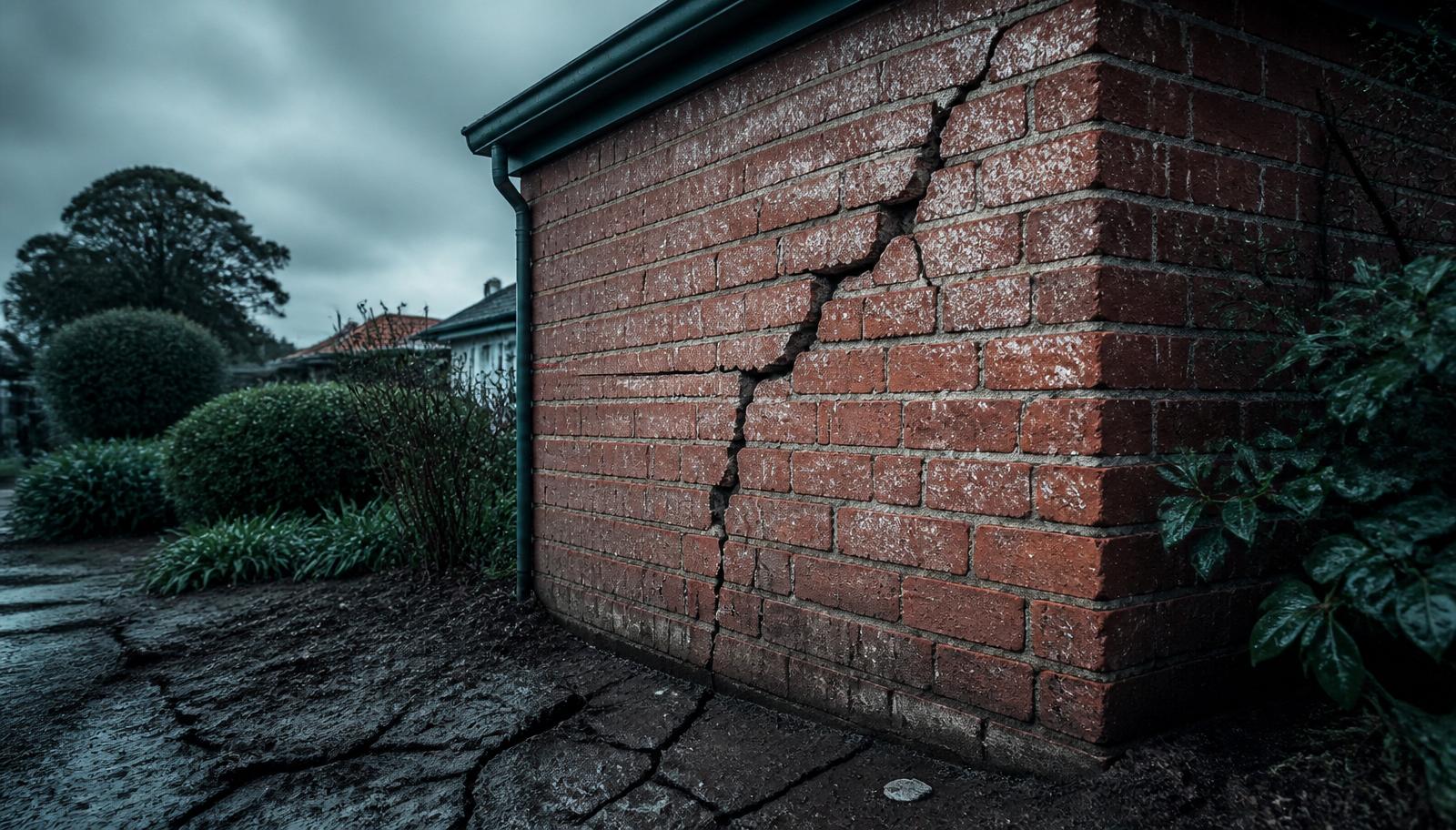
The stepped diagonal crack that appears in a Sydney brick wall in August or September looks like it happened overnight. It did not. It is the visible finish of a slow structural failure that started with a blocked gutter in April.
Sydney sits on some of the most reactive clay soils in Australia. When those soils get wet, they swell. When they dry, they shrink. Under a residential concrete slab, that cycle lifts and drops the footings by up to 40 millimetres between wet and dry seasons, which is more than enough to snap brickwork above it. A single winter of concentrated gutter overflow against one corner of the house is often the trigger that pushes a stable slab into active heave.
This guide covers what reactive clay actually does under your slab, how blocked gutters accelerate the damage, which Sydney suburbs sit on the worst ground, and why the repair bill will not be covered by your building insurance or the Sydney Water Hidden Leak Allowance.
What Reactive Clay Actually Does Under Your Slab
Every Sydney home built after the 1970s sits on a slab designed to a soil site classification set out in AS 2870 Residential Slabs and Footings. The classifications describe how much the soil moves with moisture.
- Class A stable sand or rock, movement under 10 mm.
- Class S slightly reactive clay, up to 20 mm.
- Class M moderately reactive clay, up to 40 mm.
- Class H1 and H2 highly reactive clay, up to 60 and 75 mm.
- Class E extremely reactive clay, over 75 mm.
- Class P problem sites requiring engineered footings.
Most of the Cumberland Plain, the Hills District, Blacktown, Fairfield, Liverpool, Camden and the Wollondilly sits on Class M, H1 or H2 shrink-swell clay. That is written into every 88B site classification lodged with council. The slab is engineered to tolerate uniform movement across the whole footprint, but only if the moisture around the perimeter stays reasonably even. Concentrated wetting on one corner breaks that assumption.
CSIRO research on Australian soils sets out the mechanism in plain terms. Uneven wetting causes uneven swelling. Uneven swelling lifts one part of the footing while the rest stays put. The wall above the lifted section is where the crack opens.
How a Blocked Gutter Turns Into a Cracked Wall
The failure path is short and predictable across every Sydney home we inspect after a wet winter.
- Gum leaves, jacaranda blossom and roof sediment build up over autumn and block the downpipe outlet.
- The first heavy East Coast Low in June or July overflows the gutter for hours at a time.
- Overflow water pours off the front lip of the gutter and lands in a concentrated strip along one wall of the house, usually 200 to 400 millimetres out from the slab edge.
- Reactive clay in that strip absorbs the water, swells, and lifts the perimeter footing by 10 to 40 millimetres.
- The rest of the slab stays at its normal winter moisture level and does not lift with it.
- The differential movement snaps the brickwork above the lifted corner. The crack is typically stepped, following the mortar joints diagonally.
- Spring arrives, the wet strip dries out faster than the rest of the yard, the corner drops back, and the crack widens on the return.
The whole sequence takes one wet winter. On homes with a persistent gutter blockage, it repeats every year and the cracks progressively enlarge until the brickwork loses structural integrity.
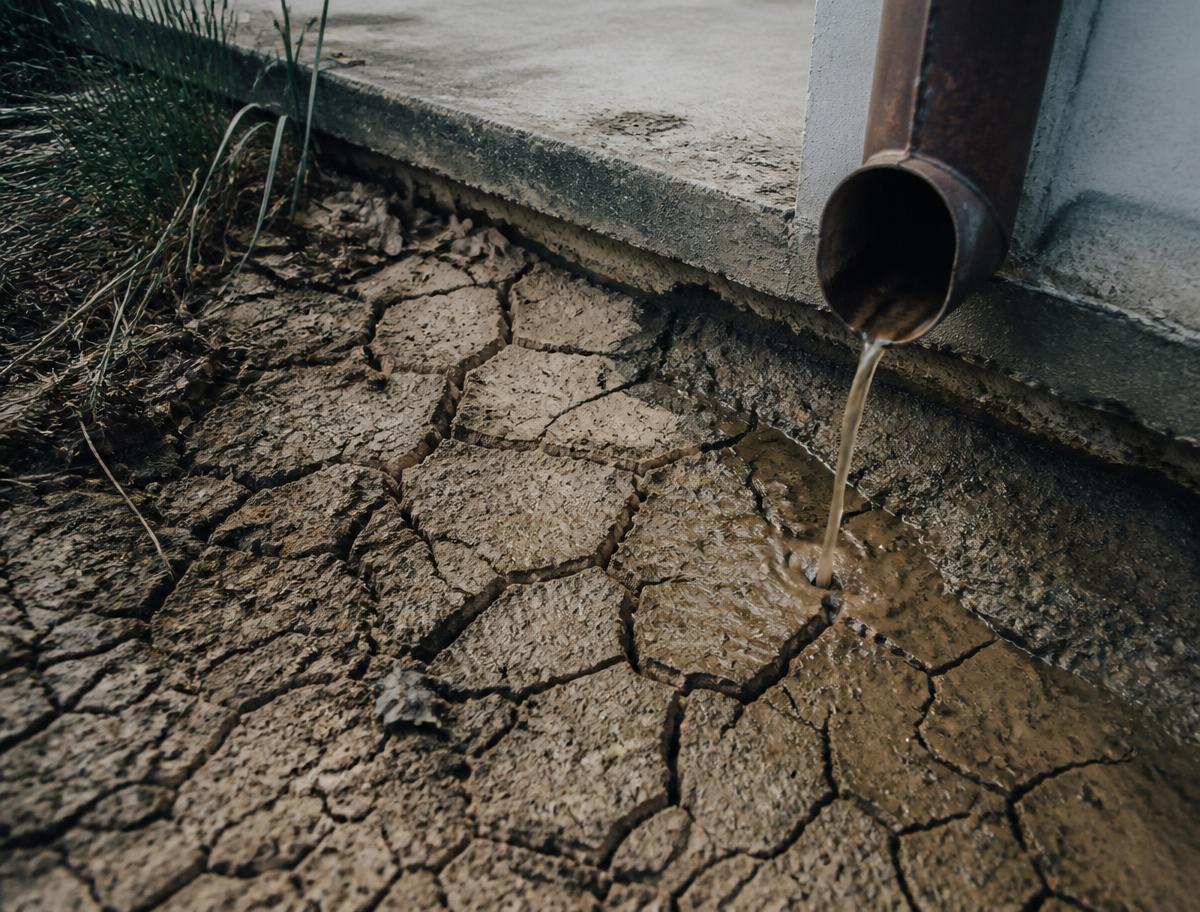
Sydney sits inside one of the largest continuous shrink-swell soil belts on the eastern seaboard. The Bureau of Meteorology's Sydney rainfall records show winter-quarter rainfall regularly exceeding 300 millimetres, which is more than enough to fully saturate a metre of clay if it is delivered into a single concentrated overflow strip rather than spread across the yard.
Sydney Suburbs Where the Ground Moves Most
The worst reactive clay is not evenly distributed. It concentrates along specific geological belts. Homes in these zones need tighter gutter maintenance schedules than the metro average.
The Cumberland Plain shrink-swell belt
Blacktown, Doonside, Mount Druitt, Rooty Hill, Riverstone, Marsden Park, Schofields and the newer Blacktown release estates sit on Wianamatta Shale. This is textbook Class H1 to H2 reactive clay. Slab heave claims from this belt make up a disproportionate share of NSW residential structural insurance disputes.
The Hills District and North West growth corridor
Baulkham Hills, Kellyville, Rouse Hill, Box Hill, North Kellyville, The Ponds and Riverstone East all sit on the same shale sequence. Newer estates have engineered footings, but many older homes across the Hills were built on Class M slabs that no longer suit the shrink-swell reality of current rainfall patterns.
South West Sydney
Camden, Narellan, Oran Park, Gregory Hills, Leppington and parts of Campbelltown sit on aggressive reactive clays. The Bringelly Shale underlying much of this area produces some of the highest recorded shrink-swell values in the state.
Inner West and Canterbury Bankstown
Older suburbs on residual clay soils including Strathfield, Burwood, Ashfield, Croydon Park, Belmore and Lakemba sit on Class M ground. Federation and post-war brick homes on strip footings are especially vulnerable because the footing depth is shallow relative to the seasonal moisture zone.
The Central Coast clay pockets
Wyoming, Kariong, Point Clare, Springfield and the Tuggerah Lakes fringe all include Class M reactive clay pockets. Central Coast homes serviced by our regional gutter cleaning team frequently show early slab heave signs after wet winters.
The Warning Signs Six Months Before the Crack Appears
Structural cracking is the last visible symptom of slab movement, not the first. Homeowners who catch the signs earlier avoid the expensive repair.
- Doors and windows sticking that were fine six weeks ago. The frame is being pulled out of square by a lifting footing. The stick is usually diagonal, catching on one top corner or one bottom corner rather than the whole leaf.
- Hairline cracks in cornices where the ceiling meets an external wall. Cornice cracks appear before wall cracks because the plaster is less tolerant of movement than the mortar below it.
- Skirting boards lifting off the floor near external corners. The floor plate is being pushed up while the skirting stays fixed to the wall.
- Tile grout cracking in a straight line across a wet area. Wet-area tiles are the earliest indicator on many slab-on-ground homes because the substrate is rigid and unforgiving.
- Gaps opening between the cornice and the wall in one corner only. Uniform seasonal movement affects the whole room evenly. A single-corner gap is a differential movement flag.
- Water pooling in a specific strip along one external wall during rain. This is the direct visual evidence that gutter overflow is concentrating on one part of the footprint.
Two or more of these signs together, in the same wet season, warrants an immediate gutter and downpipe check before the next winter cycle. Our full signs your gutters are blocked in Sydney guide covers the visible roofline evidence in more detail.
Why Sydney Water and Your Insurer Will Not Pay for This
Homeowners often assume that water damage from a gutter overflow is covered by either the Sydney Water Hidden Leak Allowance or their home insurance building policy. Neither is true, and the reasons matter.
The Sydney Water help with your bill scheme and the Hidden Leak Allowance behind it apply only to concealed leaks on the metered supply side of your property. That covers a burst copper pipe under a slab or a slow leak inside a wall cavity. It does not cover roof runoff, gutter overflow or stormwater discharge onto your own soil. Sydney Water has confirmed this position across multiple ombudsman rulings. A blocked gutter is not a leak. It is a maintenance failure.
Home building insurance follows the same logic. The Insurance Council of Australia's guidance on maintenance exclusions makes clear that gradual damage caused by lack of maintenance is excluded from every standard building policy in the market. Insurers assess slab heave claims by pulling soil samples and inspecting downpipe positions. If the assessor finds concentrated overflow evidence at the crack location, the claim is denied under the maintenance exclusion. This is the same failure mode we covered in the storm insurance claim denial guide.
NSW Fair Trading's home building disputes guidance consistently lists slab movement and moisture ingress in the top three residential building disputes. The overwhelming majority of these are ruled maintenance-related rather than construction-defect claims once the soil evidence is examined.
The practical translation is simple. Whichever way you look at it, the repair bill sits with the homeowner. Prevention is not a nice-to-have. It is the only insurance that works.
What a Proper Fix Looks Like
Repairing slab heave damage runs from 15,000 dollars for cosmetic crack stitching to over 120,000 dollars for full underpinning. Preventing it costs a fraction of that.
A structural gutter and stormwater assessment on a reactive clay site includes six things.
- Full gutter clear and downpipe flush. Every downpipe cleared to the stormwater connection and pressure-flushed to confirm flow. Book through our gutter cleaning service at the start of autumn and again in late winter.
- Downpipe outlet extension away from the slab. Downpipes discharging within 300 millimetres of a Class M or H slab need extending to at least 1.5 metres away from the foundation, ideally into a piped stormwater line rather than surface runoff.
- Gutter guard on high-debris frontages. Where gum, jacaranda or pine debris drives the blockage cycle, mesh gutter guard reduces the wet-season overflow risk. The trade-offs are covered in our gutter guard buyer's guide.
- Downpipe positioning review. Original downpipe locations are often not where the modern extension or garage was added. A single downpipe discharging behind a retaining wall or into a courtyard concentrates overflow in the worst possible place.
- Ground moisture drainage audit. Ag drain and subsoil drainage running along the perimeter footing controls the wet-season moisture that overflow otherwise concentrates.
- Written maintenance record. Every service documented with dated before-and-after photos. This is the paper trail that supports any future insurance discussion, and it is the same documentation used to defend against maintenance exclusion arguments.
The Australian Building Codes Board National Construction Code reinforces every one of these steps. AS 2870 assumes uniform moisture control around the perimeter. Concentrated overflow breaks that assumption. Restoring uniform drainage restores the design condition of the slab.
The Late-Winter Window That Matters
By the time this article publishes in late July, Sydney is already at the tail of the wet quarter. The soil under your slab is at its highest annual moisture level. Over the next eight weeks, that moisture will start to leave the ground, and the differential drying will pull whichever corner of the house has been sitting in overflow water for the past three months.
The homes that crack in September and October are the homes whose gutters were still blocked in July. The homes that do not crack are the ones that got a proper clear before the drying phase started.
If your home sits anywhere across the Cumberland Plain, the Hills District, the North West or South West growth corridors, the Central Coast clay belt, or the older Inner West suburbs on residual clay, a pre-spring gutter and downpipe service is the single most cost-effective structural insurance available.
Our team services every roof type across Sydney metro, the Central Coast, Newcastle and the Hunter, with the downpipe flow test, extension check and written report baked into every job. Call 0468 057 750 or request a free written quote and we will book you in before the ground starts drying.
Need Your Gutters Cleaned?
GutterFlow Solutions provides fast, professional gutter cleaning across Sydney, Central Coast, Newcastle & the Hunter Region.