
Sydney Water Bill Shock: How a Blocked Gutter Quietly Inflates Your Winter Costs
Why Sydney Homeowners Are Opening Bigger Bills This Winter
Walk down any street in Newtown, Marrickville, Chatswood or Erina this June and the same conversation is happening over the back fence. The water bill arrived, the heating bill arrived, and something is not adding up. Usage looks normal. Nobody changed their habits. The number went up anyway.
Some of that is pricing. Sydney Water's typical residential bill stepped up on 1 July 2025 following the IPART determination, and winter 2026 is the first full cold quarter most households are paying it on. But the bigger shock for a lot of inner Sydney and Central Coast homes is not the per-kilolitre rate. It is the slow, expensive damage a single blocked gutter does between April and August, which only shows up as a higher bill, a peeling cornice or a mould patch in the spare room after the fact.
This guide breaks down where that money actually goes, how to spot the damage early, and what to do if you think you have already been paying for it.
The Price Rise Sitting Behind Every 2026 Bill
The headline first, because it sets the context for everything below. Under the 2024 IPART determination, Sydney Water's regulated prices stepped up from 1 July 2025, with usage charges and service charges both moving. The typical residential household is paying noticeably more per quarter than they were two winters ago, and the pricing path continues annually through to 2030.
That matters for blocked gutters because the financial penalty for any water-related damage is now higher than it has ever been. A leak you would have ignored in 2022 costs real money in 2026. A wall that takes an extra week to dry out drives up your dehumidifier and reverse-cycle running costs. A hot water system fighting against damp insulation works harder for the same shower.
None of that is the gutter on its own. The gutter is the trigger. Sydney's pricing settings turn what used to be a $40 annoyance into a $400 quarter.
What Actually Happens When a Sydney Gutter Blocks in Winter
Here is the sequence almost every Sydney home goes through once a gutter blocks in May or June.
- Autumn leaf drop fills the trough with a wet mat of Jacaranda, Liquidambar and gum debris.
- The first real rain event compacts that mat into a dam. Water can no longer reach the downpipe.
- Water backs up under the first row of tiles or behind the metal sheet flashing.
- It runs along the top of the fascia, soaks the eaves, and drips into the wall cavity.
- Over weeks of repeated rain, the wall stays permanently damp. Insulation loses its R-value.
- The home gets colder. Heating runs longer. Hot water taps run longer because the bathroom feels colder.
- Hidden pipework in the wet cavity starts to corrode at the fittings, especially older copper joins.
By the time anyone notices, three things have already moved on the bill. Water usage is up because pipework is weeping inside the wall. Electricity or gas is up because the house is fighting damp air. And the next quarter brings a repair invoice for whatever rotted first.
The Five Warning Signs Most Homeowners Miss
If you only check your gutters once a year, these are the five things to look for from the ground this week. None of them require a ladder.
- Tide marks on the brickwork. A horizontal stain running below the gutter line, often with white salt deposits, is dried overflow. The wall behind it has been wet for weeks.
- Plants growing out of the gutter. Seedlings of native fig, palm or even small gum trees mean there is enough decomposed organic matter and trapped water to sustain a root system. Your gutter has become a planter box.
- Rust streaks on the fascia. Vertical orange streaks running down the fascia board from a Colorbond gutter mean water is sitting in the trough between rain events. The protective coating is failing from the inside out.
- Mossy patches on the wall under a downpipe outlet. Moss needs constant moisture. If it has colonised the bricks under a downpipe, water is leaking from that joint every time it rains, not just during storms.
- A musty smell in one specific room after rain. The room directly under the eaves of a blocked gutter is usually the first to develop a damp odour. It is the cheapest, fastest diagnostic test you have.
If you can see two or more of these, the bill increase you are seeing this quarter is almost certainly partly your gutter, not the price rise.
The Hidden Leak Allowance Most Sydney Households Never Claim
This is the part of the article that pays for itself. Sydney Water offers a concealed leak allowance for residential customers whose bills spike because of a leak they could not reasonably have known about. It is sometimes called the Hidden Leak Allowance, and most homeowners have no idea it exists until a plumber mentions it.
The headline rules, in plain English, look like this.
- The leak has to be concealed, meaning underground or behind a wall, not a dripping tap.
- You have to fix it within a defined window after discovery, with proof of the repair.
- Sydney Water can credit a portion of the excess usage back to the account.
Where gutters fit in is the part that surprises people. A blocked gutter that has been soaking a wall cavity for months can corrode a pinhole into copper supply pipework hidden in that wall. The pipework is the concealed leak. The gutter is the root cause. Once a licensed plumber confirms the leak in writing, you have a paper trail to apply for the allowance.
It does not always succeed. But for households that have been hit with a winter bill two or three times their normal usage, it is the single best lever to pull, and it is free to attempt.
Why Sydney's Climate Makes This Worse Than Other Cities
Sydney gutters fail differently to Melbourne or Brisbane gutters, and the reason matters. The Bureau of Meteorology long-term records for Observatory Hill show Sydney's rainfall is heavily front-loaded into intense events rather than spread evenly across the year. We get long dry stretches, then sudden 50 to 100 mm dumps.
That pattern is brutal on guttering for three reasons.
- Debris dries hard. A gutter that has not seen rain in six weeks bakes its leaf load into a brick. The first storm hits a sealed dam, not a flowing trough.
- Storm intensity exceeds gutter capacity. Most older Sydney homes were guttered to handle the rainfall intensities of the 1970s. A modern East Coast Low pushes well past that, and any blockage tips the system into overflow within minutes. We covered the rainfall maths in detail in our Sydney downpipe sizing guide.
- Winter dries slowly. A wet wall in January is dry in two days. A wet wall in June stays damp for a fortnight. That is the window where mould, rot and pipe corrosion start.
If you live anywhere from the Northern Beaches down to Cronulla, or out through the Hills and onto the Central Coast, you are in the band where all three factors stack. Winter is when the bill arrives.
What the Damage Looks Like Inside the House
Most Sydney homeowners assume gutter overflow stays outside the wall. It does not. Once water enters the cavity, it follows the path of least resistance, which is usually the timber framing, the top plate of the wall, and the back of the plasterboard.
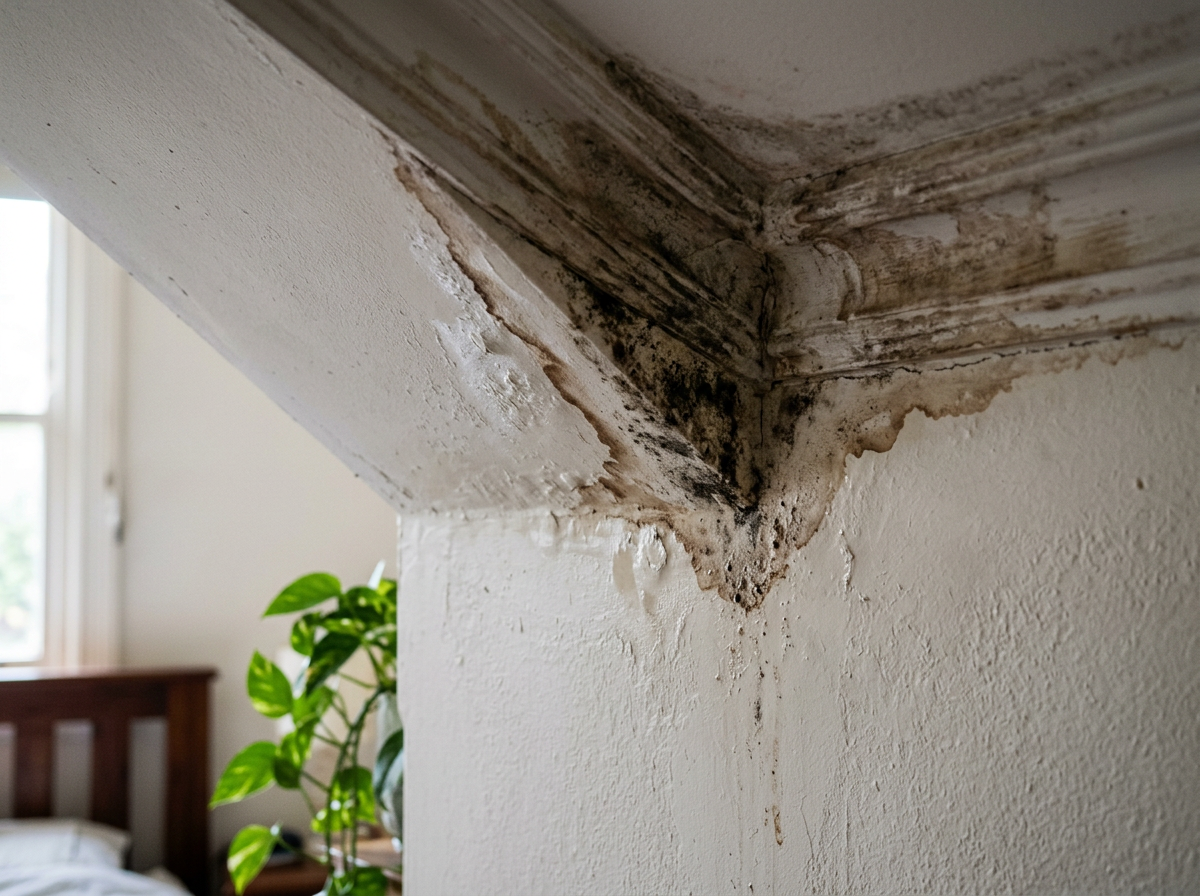
The first visible sign is rarely on the ceiling. It is usually a faint brown tide line on the cornice in the room nearest the blocked section, often along the wall that backs onto the eave. Within a few weeks, that line darkens, the paint starts to bubble, and a black or grey mould bloom appears in the corner where the ceiling meets the wall.
By that stage, three things have happened that cost real money.
- The plasterboard behind the cornice is saturated and will need replacement.
- The timber framing has absorbed enough moisture to support mould growth, which means NSW Health mould remediation guidance applies. That is not a DIY job past about one square metre.
- If the room is a bedroom, indoor air quality drops to a level that can aggravate asthma, allergies and infant respiratory health.
We covered the structural side of this in our deeper piece on fascia and soffit rot from overflowing gutters. The point here is that the bill shock has a health cost behind it, not just a financial one.
What a Proper Winter Gutter Service Actually Includes
If you have not had your gutters serviced since last spring, the question is what good actually looks like. A real winter service for a Sydney home is not someone running a leaf blower along the trough for ten minutes.
A proper service covers the full chain.
- Hand removal of compacted debris from every metre of guttering, including valleys.
- Inspection of every downpipe outlet for blockage. Most overflow events trace back to a single blocked outlet, not the trough.
- Flushing of downpipes with pressurised water to confirm the stormwater line is actually clear to the pit or street.
- Visual inspection of fascia boards, eaves and the brickwork below for existing damage.
- Photo evidence of before and after, plus a written record. You need this for both insurance and any future leak allowance claim.
That is the standard for our gutter cleaning and gutter vacuuming work, and it is what we would expect from any reputable operator in the Sydney market. If the quote is suspiciously cheap, it usually means the downpipes do not get checked.
For homes with bad leaf load and a history of repeat blockages, the longer-term fix is mesh. The Sydney gutter guard guide walks through which types actually work and which are a waste of money.
What to Do This Week if Your Bill Has Already Spiked
If you have opened a bill in the last fortnight that does not match your usage, work the problem in this order.
- Read the meter at the same time on two consecutive days with no water use overnight. Any movement means a leak somewhere in the property.
- Walk the perimeter of the house in dry weather and look at every wall under a gutter. Photograph anything that looks damp, stained, mossy or efflorescent.
- Check every room ceiling and the corners where walls meet the cornice. Photograph anything that looks discoloured.
- Get the gutters and downpipes serviced and request written before and after evidence. This becomes part of any insurance or allowance claim.
- If the meter is moving overnight, book a licensed plumber to trace the concealed leak. Their written report is what unlocks the Sydney Water allowance.
- Lodge the concealed leak application with Sydney Water as soon as the repair is documented. Do not wait. The window for backdated credit is finite.
We have written separately about how this same paper trail protects you when storm insurance claims get denied over gutter maintenance. The same records do double duty.
Frequently Asked Questions
Can a blocked gutter really increase my water bill?
Indirectly, yes. The gutter itself does not draw water. What it does is keep wall cavities and underfloor areas chronically damp, which corrodes hidden pipework over months. Once a pinhole leak develops in a concealed copper line, the meter starts running quietly day and night. That is what shows up on the bill.
How do I know if I qualify for the Sydney Water concealed leak allowance?
You qualify if the leak is genuinely concealed (underground or behind a wall, not a visible dripping fitting), you fix it within Sydney Water's stated window, and you have a licensed plumber's written report. Apply through Sydney Water directly. Most successful claims have photo evidence and a clear repair invoice.
My gutters look clean from the street. Could they still be blocked?
Yes, and this is the most common false reassurance we deal with. The blockages that cause winter damage are almost always at the downpipe outlet, not in the trough itself. You cannot see them from the ground. The only way to be sure is a visual inspection from a ladder or a drone, plus a flush test on each downpipe.
How often should Sydney homes service their gutters?
For most properties, twice a year, once after autumn leaf drop and once before the summer storm season. Homes with heavy gum or Jacaranda overhang need three to four cleans a year, or a properly fitted gutter guard. We covered the full schedule in our how often to clean gutters guide.
Is gutter overflow covered by home insurance?
Sudden storm damage usually is. Damage from gradual overflow caused by poor maintenance usually is not, and most insurers will ask for service records before paying out. Keeping written cleaning records protects you on both fronts.
What does a winter gutter service cost in Sydney?
Most single-storey Sydney homes sit in the $200 to $350 range for a full clean, downpipe flush and written report. Double-storey, complex rooflines and properties with heavy debris cost more. We break down the full pricing in our gutter cleaning cost guide.
Can I clear the gutters myself instead?
You can, but the falls-from-height statistics from SafeWork NSW are sobering, and most insurance allowance claims need a professional report anyway. We wrote about the real risk in our DIY ladder safety piece.
The Real Cost of Doing Nothing This Winter
The honest summary is this. Sydney Water pricing went up, and it is staying up. Winter rainfall patterns are doing what they always do. The homes that get through the next three months without a bill shock are the ones whose gutters are flowing and whose downpipes are clear right now, not the ones whose owners plan to look at it in spring.
A single service costs less than one quarter of inflated bills. A proper paper trail is worth thousands if a leak develops behind the wall. And the difference between a $250 clean in July and a $4,000 wall repair in October usually comes down to one decision made on one weekend.
If your roofline is in Sydney, the Central Coast, Newcastle or the Hunter, our team services every kind of guttering, from heritage terrace box gutters to modern Colorbond fascia systems.
📞 Call 0468 057 750 for a same-week winter inspection, or request a free written quote. Every job comes with before and after photos and a written service record you can keep for insurance and Sydney Water.
Need Your Gutters Cleaned?
GutterFlow Solutions provides fast, professional gutter cleaning across Sydney, Central Coast, Newcastle & the Hunter Region.