Sydney Bushfire Prep: Why Blocked Gutters Ignite First
The Sydney Reality Behind Every Bushfire Season
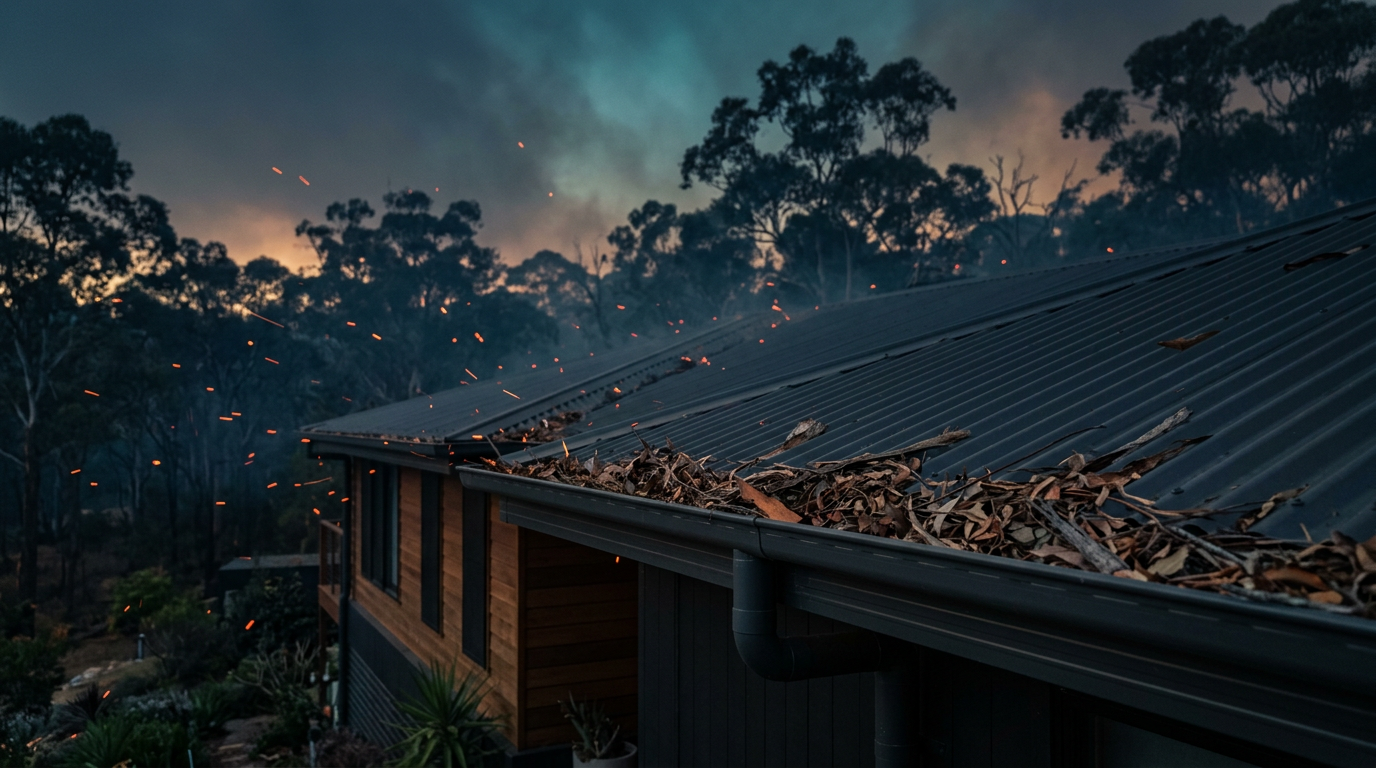
Every Sydney bushfire season, the news cameras go to the flame front. The houses that actually burn tell a different story. Post-incident reports across NSW keep finding the same pattern: most homes lost to bushfire were never touched by direct flame at all. They ignited from tiny windborne embers that drifted a kilometre or more ahead of the fire, landed on a roof, and found a bed of dry eucalyptus leaves waiting for them in a blocked gutter.
If you live anywhere from the Blue Mountains foothills through the Hills District, the North Shore bushland belt, the Northern Beaches ridge lines, the southern Sutherland Shire, or the bush edges of the Central Coast and Hunter, this is the risk that matters more than any single wind gust or temperature reading.
Australia's statutory bushfire danger period opens on 1 October across most NSW local government areas. From that date the RFS controls burning permits and expects properties to be ready. July is the last stretch of quiet weather before that clock starts. It is the correct month to fix the ember pathway, not the week the total fire ban is declared.
Why Ember Attack, Not Flame Front, Is How Sydney Homes Burn
Ember attack is a technical term with a plain meaning. As a bushfire runs through eucalypt canopy, it lofts burning bark strips, gum leaves and twigs into the smoke column. Strong updrafts carry those embers well ahead of the fire, and the wind drops them on rooftops far from any visible flame. Post-Black Summer research summarised on the Black Summer bushfires overview reinforced what CSIRO had already published in its long-running bushfire research program: the vast majority of homes destroyed in the 2019 to 2020 season ignited from ember attack, not from the flame front itself.
Two things about that pattern matter for gutters specifically.
- Embers can arrive hours before the fire is visible on the horizon, and hours after it has passed. The house is at risk for a much longer window than most homeowners assume.
- A single ember only needs one thing to start a house fire, and that is a dry fuel bed to sit on. A gutter packed with cured gum leaves, curled bark ribbons and small twigs is close to ideal.
Once a gutter ignites, the fire moves in two directions. Downward through the fascia and eaves into the roof cavity, and outward along the length of the gutter run because the fuel is continuous. By the time it is visible from the street it is usually inside the roof space.
The 1 October Deadline Most Sydney Homeowners Miss
The NSW Rural Fire Service sets a statutory bushfire danger period each year. For most Sydney and surrounding LGAs it opens on 1 October and runs through to 31 March. From that opening date, the RFS restricts open burning, and the Get Ready program formally treats every property owner as responsible for their own preparation.
Two consequences of that date matter for a gutter service booking.
- Demand for licensed gutter and roof contractors spikes hard in September as homeowners realise the deadline is a fortnight away. By mid-September most reputable operators in the ember-prone belt are already fully booked into November.
- Bushfire prep works best on dry, calm days. Sydney winter weather still gives you those days through July and August. Once the westerly wind pattern sets in through spring, safe roof access windows shrink.
That is why the seven-week gap between mid-July and early September is the correct booking window, and it is the one most Sydney homeowners miss.
What Actually Ignites in a Blocked Sydney Gutter
The mechanism is worth understanding because it changes how you think about gutter cleaning. It is not really about water anymore once the season turns.
A blocked gutter in bushfire country holds three fuel types in the same trough.
- Cured eucalyptus leaves. Dropped through the previous summer and autumn, dried down to under 10 percent moisture through winter sun.
- Ribbon bark from stringybarks and ironbarks. The most flammable roofing debris in Australia by volume, because the fibres are open and catch embers on contact.
- Small twigs and seed capsules. Slower to ignite but sustain the fire once it starts.
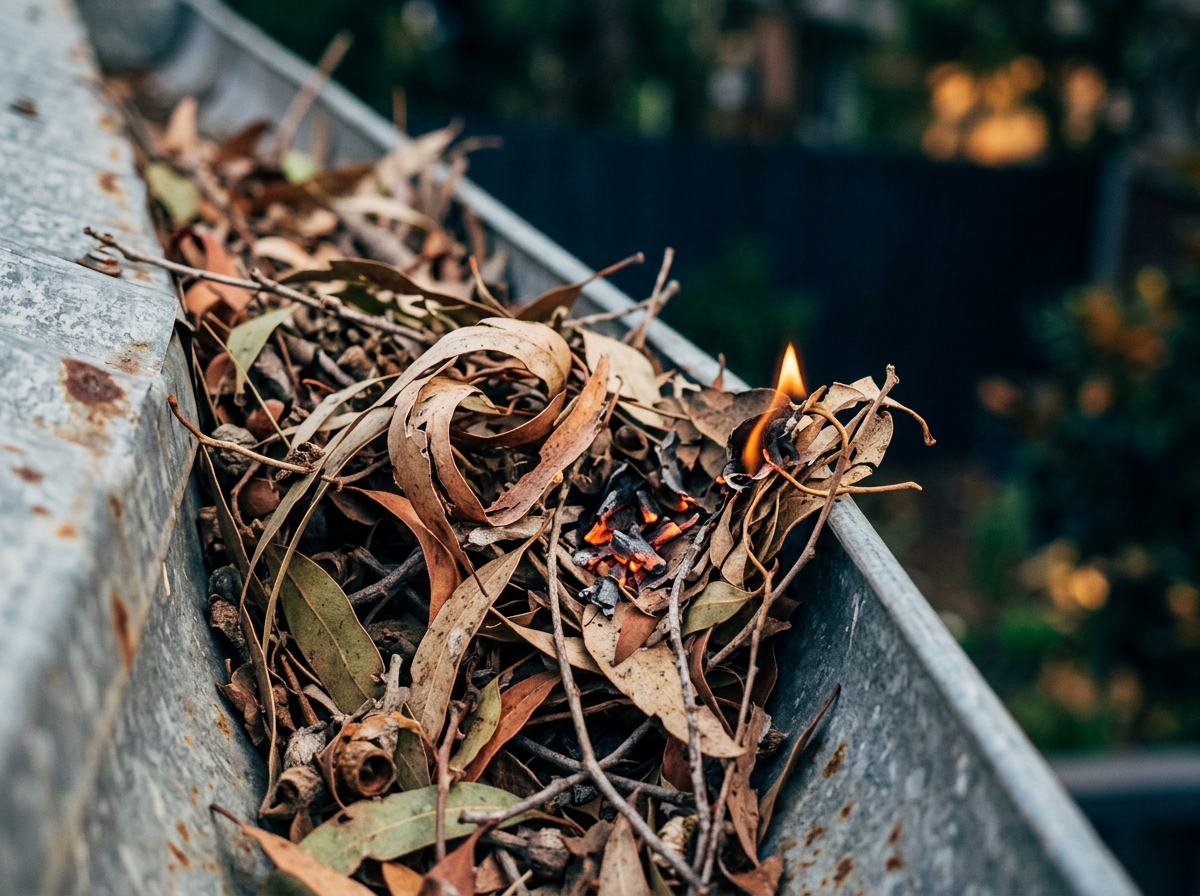
An ember lands, glows for a few seconds, and either burns out on a clean gutter or ignites on that fuel bed. Once the flame is a few centimetres wide, radiant heat softens the plastic downpipe joins, cracks the fascia paint, and starts the eave and top plate warming from above. A gutter fire that runs for ten minutes unattended is usually a roof cavity fire by the time anyone notices it.
There is a second, less visible failure mode. Embers can drop through gutter guard mesh that is too coarse, or through the gap between an incorrectly fitted guard and the roof edge, and lodge underneath. That situation looks tidy from the ground and is more dangerous than a visibly blocked gutter, because the fuel is invisible until it is already burning.
Sydney Suburbs Where Ember Risk Concentrates
Ember attack risk is not spread evenly across the metro area. The homes we service under the highest combined risk fit a small number of patterns.
- Blue Mountains foothills and Hawkesbury fringe. Winmalee, Yellow Rock, Faulconbridge, Bilpin, Kurrajong and surrounding streets sit inside declared bushfire prone land under the NSW planning framework.
- Hills District bush edges. Kellyville Ridge, Glenhaven, Dural, Galston and Middle Dural back onto reserves that carry dense eucalyptus fuel.
- North Shore bushland belt. East Killara, St Ives Chase, Wahroonga, Turramurra, Warrawee and the Ku-ring-gai reserve edges all get heavy bark and leaf load from adjacent parkland.
- Northern Beaches ridges. Duffys Forest, Terrey Hills, Ingleside, Cottage Point and the escarpment above Avalon and Bilgola sit above continuous bush.
- Southern Sutherland Shire. Bangor, Menai, Illawong, Alfords Point and Woronora Heights all border the Royal or Heathcote National Parks.
- Central Coast and Hunter fringe. Kincumber South, Terrigal ridges, Wamberal escarpment, Killcare Heights, Warners Bay hills and Kotara South all face similar exposure.
If your street matches any of those, the gutter conversation shifts from water management to fire management for six months of the year. The scheduling logic in the how often to clean gutters in Sydney guide still applies, but you tighten the pre-October clean into a hard deadline instead of a rolling recommendation.
What AS 3959 and the National Construction Code Require
Any Sydney property inside a designated bushfire prone area is subject to a Bushfire Attack Level, commonly written as BAL. The rating runs from BAL LOW through BAL 12.5, BAL 19, BAL 29, BAL 40 and BAL FZ, where FZ means Flame Zone. The rating is set at the planning stage and drives the construction requirements the home must meet.
Those requirements come from AS 3959 Construction of buildings in bushfire prone areas, incorporated into the National Construction Code as the reference standard. AS 3959 covers gutters directly in several places.
- Roofs and eaves must be constructed to prevent the accumulation of debris where reasonably practicable, which in practice means gutter guards or leaf screens are required from BAL 12.5 upward.
- Gutter and downpipe materials must be non-combustible from BAL 12.5 upward. PVC downpipes are non-compliant at those ratings and above.
- Any gap that could allow embers into the roof space must be sealed, including the gap behind the gutter and above the fascia where roof sheets terminate.
- At BAL 40 and BAL FZ, the gutter guard mesh aperture is capped at 2 millimetres to stop embers passing through into the trough.
For homeowners, the NSW Fair Trading Bushfire Attack Level page is the plain-English version of the same rules, and it is what your insurer will refer to if a claim ever hinges on compliance.
The BOM seasonal climate outlook reinforces the same point on the weather side. For most of the past decade, the NSW east coast has entered spring with above-average temperatures and below-average soil moisture. That is the combination that makes an ordinary blocked gutter into an ignition point.
The Pre-Season Gutter Checklist for Bushfire-Prone Sydney
If your home sits inside a bushfire prone area, the checklist below is what a proper pre-season service should include. Print it, tick it, and keep the dated photos on file.
- Full hand or vacuum removal of every leaf, bark strip, twig and seed capsule from every metre of gutter trough, including valleys and any box gutter section.
- Removal of debris from behind any existing gutter guard, not just above it. Debris trapped between the mesh and the roof sheet is the failure mode that surprises most homeowners.
- Individual downpipe flush to confirm the stormwater line is clear, and inspection of the discharge point at ground level. A blocked downpipe forces overflow through the gap behind the gutter, which is also the ember entry point.
- Visual inspection of fascia, eaves, roof sheet edges and any exposed timber for existing scorch marks, cracking paint or dry rot that would accelerate ignition.
- Check of the gutter guard mesh aperture against the property BAL rating. Anything above 2 millimetres at BAL 40 or FZ is non-compliant and needs replacement.
- Written report and dated before and after photos. This paper trail is what protects you if an insurance claim ever hinges on maintenance evidence, following the same logic set out in the Sydney storm insurance claim guide.
- Removal of overhanging branches within 2 metres of the roof line where possible, or documentation of the request to the local council if the tree is on public land.
Our own gutter cleaning service in bushfire-prone suburbs follows that sequence as standard, including the debris-behind-mesh check that most quick-clean operators skip. The complete blocked gutters guide covers the water-side symptoms, and the checklist above extends that into the fire side.
Gutter Guard: What Works Under Ember Attack, What Fails
Gutter guard is the single most misunderstood product in bushfire preparation. The wrong mesh can be worse than no mesh at all because it makes the gutter look protected while trapping fuel out of sight.
The rules that actually matter under ember attack are straightforward.
- Aperture size caps at 2 millimetres for BAL 40 and BAL FZ homes. Anything larger admits embers.
- Aluminium or stainless steel mesh only in ember-prone areas. Plastic mesh melts and drops the fuel bed straight onto the roof sheet under sustained radiant heat.
- The mesh must sit flush with the roof sheet, with no gap at the fascia end. A 5 millimetre gap between mesh and sheet is the same as no mesh.
- The mesh must be maintained. A neglected guard is a hidden fuel bed, and hidden fuel is the worst kind.
The full breakdown is in the Sydney gutter guard guide, including the material comparison and pricing. If you already have gutter guard and you cannot remember when it was last lifted for inspection, treat that as an urgent pre-season job, not a nice-to-have.
The Insurance and Compliance Angle Most Homeowners Miss
Home insurance in bushfire prone Sydney is one of the fastest-changing sections of the general insurance market. Premiums have risen sharply across the ember-prone belt for four consecutive years, and insurers are asking more detailed maintenance questions at renewal.
Two practical points matter.
- A documented, dated pre-season gutter clean is the single easiest maintenance record to keep on file. It costs a few hundred dollars, takes an hour or two, and produces the photo evidence that supports a claim if the worst happens.
- Damage from ember attack is usually treated as bushfire damage, which is a covered peril in almost every standard home policy. The exclusion risk sits elsewhere. If an assessor can show that a blocked gutter caused a preventable ignition, the insurer may reduce or decline a claim on the basis of a maintenance failure, not the bushfire itself.
The same paper-trail logic we set out in the storm insurance claim guide applies directly here. The photographs and invoices you keep between July and September are what stand up in an assessor's file in October.
Why DIY Is a Worse Trade in July Than in April
Winter roof access in Sydney is not benign. Wet metal roofs, moss on tiles, ladder feet slipping on cold paving and pollen slicks on the roof surface all raise fall risk sharply through July and August. SafeWork NSW fall-from-height data consistently shows the residential ladder injury rate climbing through the mid-winter months for exactly those reasons.
The Sydney DIY gutter ladder safety piece covers the risk numbers in detail. For a bushfire-prone home the calculation is worse than in autumn, because the debris load is at its heaviest and the surfaces are at their slipperiest at the same time.
A professional service on a Sydney single-storey home in the ember belt typically runs between $250 and $400 for a full pre-season clean with written report. The gutter cleaning cost guide breaks the pricing down by roof pitch, height and access. Weighed against the insurance and structural exposure, that number is the smallest line item in the bushfire preparation budget.
Frequently Asked Questions
When does the NSW bushfire danger period actually start?
The statutory bushfire danger period across most Sydney and surrounding LGAs opens on 1 October and runs through to 31 March. Some LGAs bring the date forward or extend it based on fuel and weather conditions. The RFS publishes the current list each year and can bring the period forward under emergency declarations.
Do I really need to clean my gutters if I have a gutter guard fitted?
Yes. Gutter guard reduces the debris load reaching the trough, but it does not eliminate it. Debris accumulates on top of the mesh, and finer particles fall through and pack the trough beneath. Debris also collects behind and underneath the mesh where it is invisible from the ground. Pre-season inspection lifts the mesh and clears both zones.
What Bushfire Attack Level triggers gutter guard requirements?
Non-combustible gutter and eave protection is required from BAL 12.5 upward under AS 3959. Mesh aperture is capped at 2 millimetres for BAL 40 and BAL Flame Zone homes. Your BAL rating is set by a certified assessor at planning stage and is on file with your local council.
Can I burn off the gutter debris myself?
No. Open burning is restricted during the bushfire danger period and is subject to permit requirements from the RFS even outside that window. Bagging debris and taking it to a green waste facility is the correct disposal method for gutter debris in bushfire prone areas.
Is ember damage to my roof covered by home insurance?
Ember attack damage is generally treated as bushfire damage, which is a covered peril in almost every standard home policy. The exclusion risk sits in maintenance neglect. Documented pre-season gutter cleaning protects the maintenance side of any claim.
How close to a bushland reserve counts as bushfire prone?
The formal definition is set by each local council under the NSW planning framework. In broad terms, any property within 100 metres of designated bushfire prone vegetation is classed as bushfire prone. If in doubt, request the BAL rating certificate through your council or a certified assessor.
Should Central Coast and Hunter homes follow the same schedule?
Yes. The statutory bushfire danger period covers the Central Coast, Newcastle and most Hunter LGAs on the same 1 October opening date, and the same pre-season logic applies. Suburbs backing onto Brisbane Water National Park, Bouddi National Park, Wyrrabalong or the Watagans should treat the July-to-September window as the compliance deadline.
The July Decision That Protects Your House Through Summer
The 1 October date is not the start of Sydney's bushfire season in any meaningful sense. It is the finish line for pre-season preparation. Ember risk is already building through August as fuel loads dry down, wind patterns shift westerly, and the RFS moves from planning mode into active response mode.
If your home sits anywhere across the ember-prone belt, the question is not whether to clear the gutters. It is whether to do it in July on a professional booking, or in October on a scrambled one after the first hazard reduction burn day. The July version is cheaper, safer and produces the paper trail your insurer wants. The October version is neither.
If your roofline is anywhere across Sydney metro, the Blue Mountains foothills, the Central Coast, Newcastle or the Hunter, our team services every roof type across the bushfire-prone belt, with the debris-behind-mesh check, downpipe flush and written pre-season report baked into every job.
📞 Call 0468 057 750 to book a same-week pre-season inspection, or request a free written quote. Every service comes with before and after photos, a written record and a BAL-aware gutter guard check you can hand to your insurer or council.
Need Your Gutters Cleaned?
GutterFlow Solutions provides fast, professional gutter cleaning across Sydney, Central Coast, Newcastle & the Hunter Region.