
Sydney Fascia & Soffit Rot: The Hidden Cost of Overflowing Gutters
What Fascia and Soffit Actually Do on a Sydney House
Walk up to almost any Sydney home from the front yard and look at the edge of the roof. The flat horizontal board the gutter is screwed into is the fascia. The lining underneath the eaves overhang, between the fascia and the wall, is the soffit. Together they form the sealed timber and sheet collar around the roof. Their job is simple. Hold the gutter straight, close off the roof cavity so wind, water and possums stay out, and give the roof line its finished look from the street.
On older Sydney housing stock the fascia is almost always painted Oregon, Tasmanian Oak or hardwood, sometimes 30 to 80 years old, sitting directly behind a steel or aluminium gutter. The soffit is usually fibre cement sheet on newer homes, original tongue and groove timber on Federation and Californian Bungalow homes, and a mix of cement sheet and timber battens on post-war brick veneer. None of those materials are designed to be wet for long. They are designed to be dry, behind a working gutter, for the entire life of the building.
That single condition is what fails when a gutter overflows. The fascia and soffit go from dry, ventilated and sealed to wet, dark and unventilated. Once that happens, the clock on rot, swelling, paint failure and structural damage starts running quietly, often for years, before anyone notices.
Why Sydney's Winter Gutter Overflow Is the Main Cause of Fascia Rot
People assume the worst gutter weather is the summer southerly buster. For the fascia and soffit, the real damage comes from winter. The reason is the same one that makes box gutters fail on inner Sydney terraces, and we covered the storm side of it in our East Coast Low winter prep guide. A short summer thunderstorm overflows the gutter for a few minutes and the timber dries out within hours. A winter East Coast Low parked off the coast for two or three days keeps the back of the fascia wet the entire time. The Bureau of Meteorology's East Coast Low data shows these systems most commonly arrive between May and August, exactly when ambient humidity is high and timber dries slowest.
When a Sydney gutter overflows in winter, the water rarely spills cleanly off the front lip. It is far more likely to flow backwards along the underside of the gutter, tracking into the gap between the gutter and the fascia. From there it has two paths. It runs down the back of the fascia, where the paint film is thinner and often unmaintained. Or it wicks up into the soffit lining and the rafter ends. Either path puts liquid water in direct contact with timber that was never meant to see it.
The result over a single winter is rarely catastrophic. The result over three winters of gum leaf blockages and skipped cleans is a fascia that has gone soft enough to push a finger into.
The Hidden Leak Allowance Does Not Cover This Damage
Sydney homeowners often discover the financial side of fascia damage at the worst possible moment. The IPART Sydney Water price determination that took effect on 1 July 2025 raised typical residential bills by 18 to 23 per cent and locked in further annual increases through 2030. That alone is enough to make any wasted litre painful.
The bigger trap is the Sydney Water Hidden Leak Allowance. The allowance is a one-time credit Sydney Water applies when a licensed plumber confirms a concealed leak in your private pressurised pipework. It is widely misunderstood as a general water-damage safety net. It is not. The allowance only covers water that escaped from your supply line. Rainwater that spilled out of a blocked gutter, soaked the fascia and ran into a wall cavity is not eligible for any credit at all.
That distinction matters because the damage looks identical from the inside. A brown stain on a ceiling cornice, a swollen architrave, a musty smell behind a wardrobe. The homeowner reports it as a leak, the plumber traces it back to a gutter overflow, and the Sydney Water rebate disappears from the table. The full restoration cost stays on the homeowner.
With water bills rising and the allowance carved into such a narrow definition, the cost of letting a gutter overflow has quietly doubled in the last two years. A regular gutter cleaning visit that used to be a discretionary spend is now the cheapest piece of insurance on the property.
Five Early Warning Signs You Already Have Fascia or Soffit Damage
The damage starts small. By the time it is visible from the footpath, the repair has already moved from cosmetic to structural. These are the five signs Sydney homeowners should walk around and check this month, before the next storm.
- Paint bubbling or peeling in vertical streaks directly behind the gutter line, especially on the southern and eastern faces of the house where the sun does not reach to dry the timber.
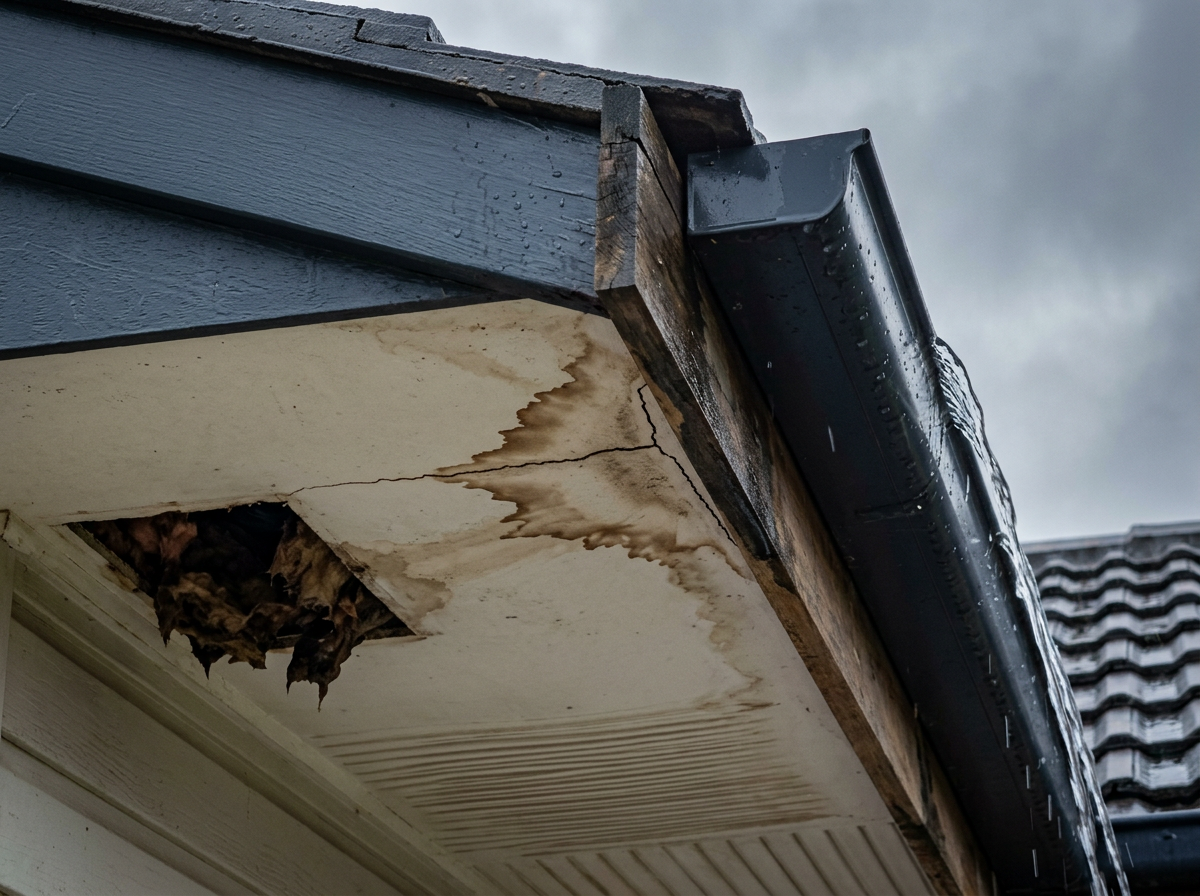
- Brown tide marks on the underside of the eaves lining, often radiating out from the corner where the fascia meets the soffit.
- A gutter that is starting to lean forward away from the fascia, or visible daylight between the back of the gutter and the timber.
- Soft timber when you press a screwdriver into the fascia from underneath. Healthy timber resists. Rotted timber gives like cork.
- Gutter brackets pulling out of the fascia, missing screws on the ground, or a section of gutter that has dropped lower than the rest.
We covered the upstream version of these signs in our guide on blocked gutters in Sydney. Fascia damage is what those blockages turn into when they go untreated for one or two winters.
How Fascia Rot Spreads Into the Roof Structure
The reason fascia rot becomes expensive is that the fascia is not a standalone trim board. It is fixed to the ends of the rafters, the truss tails, or the barge beam. Once water reaches the back of the fascia, it has a direct path into the structural timbers of the roof.
The first thing to go is the rafter end. The exposed cut face of the rafter sits behind the fascia with very little paint protection. When the fascia stays wet, the rafter end starts to swell, the nail holding the gutter bracket loosens, and the bracket pulls forward another millimetre. That millimetre lets more water in next time it rains. The cycle accelerates.
The second thing to go is the soffit lining. Cement sheet soffit does not rot, but it does soak up water and stain. Timber soffit on Federation and Californian Bungalow homes rots in the same way the fascia does, often faster because the underside collects very little direct sunlight. Once the soffit fails it stops sealing the roof cavity, which lets wind drive rain straight up into the insulation.
The third thing to go is the insulation and ceiling above it. Wet insulation loses its R-value within a single soaking and can sit damp for weeks under a Colorbond or terracotta roof. The ceiling plaster directly below it starts to bow, paint cracks in a brown halo around the lighting points, and eventually the cornice line separates from the wall. That is the point at which the repair stops being a roof-edge job and becomes a partial reroof, an insulation replacement, a ceiling rebuild and an internal repaint, all at the same time.
The order is always the same. Fascia, soffit, insulation, ceiling. The cost of stopping at stage one is a fraction of the cost of repairing all four.
Common Sydney Housing Stock and Where the Damage Starts
Fascia rot does not affect every Sydney home the same way. The era and roof style of the house decide where the damage shows up first.
- Inner-city Victorian and Federation terraces in Paddington, Surry Hills, Glebe and Newtown. Concealed box gutters behind the parapet do most of the damage to the rear roof, but the front eaves fascia on the verandah is the most overlooked spot.
- Californian Bungalows in the inner west, Marrickville, Earlwood and Strathfield. Wide eaves with original timber soffit lining are the classic failure point because the soffit is the lowest, darkest, slowest-drying part of the house.
- Post-war brick veneer in Ryde, Eastwood, Carlingford and Bankstown. Original galvanised gutters often outlast their fascia, especially on the southern wall where moss and lichen grow on the eaves.
- Coastal Northern Beaches and Eastern Suburbs homes in Manly, Dee Why, Coogee and Maroubra. Salt-laden air accelerates both gutter corrosion and fascia paint failure, and we covered the wider effect in the coastal salt air gutter guide.
- Modern Hills District and North Shore homes with metal fascia capping. The capping itself is durable, but the silicone seal between the cap and the gutter is the weak point and lifts after about ten years of UV exposure.
In every one of these property types, the gutter is the upstream cause and the fascia is the downstream casualty. The fix has to address both together, which is why a gutter repair job on an older Sydney home almost always reveals fascia damage that needs work at the same time.
What a Proper Fascia and Soffit Repair Actually Involves
The most common mistake homeowners make is asking a painter to repaint over rotted fascia. A coat of exterior gloss seals the moisture in, the rot continues underneath, and the new paint lifts within a winter. A proper repair has to remove the wet timber back to sound material before any new finish goes on.
A standard scope on a Sydney home looks like this. The gutter is unscrewed and supported on temporary brackets. The fascia is inspected end to end, and any soft section is cut out back to a rafter, not back to where it looks dry. New fascia is scarf-jointed or full-length replaced and primed on every face, including the hidden back face, before refitting. Any damaged soffit sheet is removed, the rafter ends are treated with a borate or copper-naphthenate preservative, and new sheet is fitted with a small ventilation gap.
The gutter is then refitted with new brackets at the correct centres and the correct fall toward the downpipe, ideally with new high-tensile screws into solid rafter rather than into fascia alone. Where the existing gutter is past its useful life, this is the natural moment to move to a new Colorbond gutter installation with a matching fascia capping. Doing the two jobs together is significantly cheaper than coming back later to replace either one in isolation, and the matching profile and colour give the roof line a single clean finish that holds value at resale. We compared this trade-off in detail in gutter repair vs replacement in Sydney.
Compliance matters here too. The plumbing drainage side of any gutter and downpipe work is covered by AS/NZS 3500.3, and the Australian Building Codes Board sets the broader National Construction Code requirements that any reroof or fascia-replacement job has to meet. A licensed installer should be able to point to both without being asked.
How to Stop the Cycle: A Winter Maintenance Plan That Actually Works
Fascia rot is preventable. It is preventable for less than the cost of a single repaint of one elevation of the house. The problem is that most Sydney homeowners only think about gutters once a year, and once a year is not enough for a property under any meaningful tree canopy.
The right cadence for almost every Sydney home is twice a year. The first clean should land in late autumn, ideally in May, ahead of the East Coast Low season. The second should land in late November or early December, after the spring jacaranda and gum leaf drop has passed. Homes under heavy gum trees, on bushland blocks in the upper North Shore or Hills District, or close to the coast where salt accelerates corrosion, often need a third visit in midwinter to clear what blew in during the first storms. For multi-storey or hard-access homes, a gutter vacuuming visit avoids the ladder time that drives most DIY accidents, and the NSW SES storm-safe guidance explicitly recommends professional clearing ahead of severe weather.
Where the property is consistently leaf-loaded, the long-term answer is a gutter guard installation. A correctly sized mesh in the right aperture stops the leaf load before it reaches the gutter, which means the water sheet stays inside the gutter where it belongs and the fascia stays dry. The wrong guard, fitted at the wrong angle, makes the problem worse because it traps debris on top of the mesh and channels overflow straight onto the fascia. The difference is design, not brand, and we walked through it in the Sydney gutter guard guide.
Two other things make a measurable difference. Keep a written record of every clean and every inspection, because that record is what turns a denied insurance claim into a paid one. We covered the exact format in our storm insurance claim denied guide. And if you own in a strata building, confirm with the committee in writing who is responsible for the eaves and fascia before any work is booked. The NSW Fair Trading building and renovating guidance sets the consumer protection baseline, and the practical strata side is in our Sydney strata gutter maintenance guide.
The pattern across every Sydney property type is the same. The houses that go decades without fascia rot are not the ones with the best timber. They are the ones where the gutters get cleaned on a schedule, the downpipes get flushed at the same time, and any small overflow is treated as a fault to fix, not a quirk to ignore.
Frequently Asked Questions
How can I tell if my fascia or soffit is already rotting?
Look for paint that has bubbled or peeled in vertical streaks behind the gutter, brown tide marks on the eaves lining underneath, soft timber that gives when pressed with a screwdriver, a gutter that is starting to lean forward at one bracket, or visible daylight where the fascia meets the soffit. Any one of these signs means water has already moved past the gutter line.
Will my home insurance cover fascia and soffit damage?
Most Sydney home insurers treat fascia and soffit rot as a maintenance issue, not a sudden event, so it is usually excluded. The exception is when a single identifiable storm caused the failure and you can show a recent cleaning record. Without that record the claim is almost always denied as gradual deterioration.
Does the Sydney Water Hidden Leak Allowance apply to gutter overflow damage?
No. The Hidden Leak Allowance only applies to water lost from the pressurised supply pipework on your property when a licensed plumber confirms a concealed leak. Rainwater that has spilled out of a blocked or undersized gutter is not eligible for any credit on your Sydney Water account.
How often should I get my gutters cleaned in Sydney to protect the fascia?
For most inner and coastal Sydney homes the right interval is twice a year, once in late autumn before the East Coast Low season and once in early summer after the spring jacaranda and gum leaf drop. Homes under heavy tree canopy or close to the coast often need a third visit.
Can fascia be replaced without removing the gutter?
Rarely. Because the gutter is bracketed directly into the fascia board, any meaningful fascia repair involves taking the gutter down, removing the rotted section back to sound timber or steel, fitting new fascia or fascia capping, then refitting or replacing the gutter. Trying to patch fascia in place almost always traps moisture and fails again within a season.
Is timber fascia worth keeping, or should I switch to metal fascia capping?
On a Sydney home that already has overflow damage, capping the existing fascia with a powder-coated metal cover or moving to a full Colorbond fascia system is the more durable choice. It removes the food source for rot, locks out wind-driven rain, and pairs cleanly with new Colorbond guttering for a single sealed roof edge.
Get Ahead of the Damage Before the Next East Coast Low
Winter 2026 has already started. The next East Coast Low is a matter of weeks away, not months. If the fascia on your home has been ignored for two or three years, a single inspection now is the difference between a routine clean and a five-figure repair bill in August.
GutterFlow Solutions runs licensed and insured gutter cleaning, vacuuming, repair and replacement across Sydney, the Central Coast, Newcastle and the Hunter Region. Every visit includes a written eaves and fascia condition report, before and after photos, and a copy for your insurance file. Call 0468 057 750 or request a free written quote and get the roof edge of your home checked before the rain does it for you.
Need Your Gutters Cleaned?
GutterFlow Solutions provides fast, professional gutter cleaning across Sydney, Central Coast, Newcastle & the Hunter Region.