
Sydney Strata Gutter Maintenance: Who's Actually Responsible in 2026
The First Sign Is Always the Top-Floor Ceiling
The first call usually comes from the top-floor unit. A brown ring is spreading across the bedroom ceiling after a single overnight downpour, and the owner wants to know who is paying to fix it.
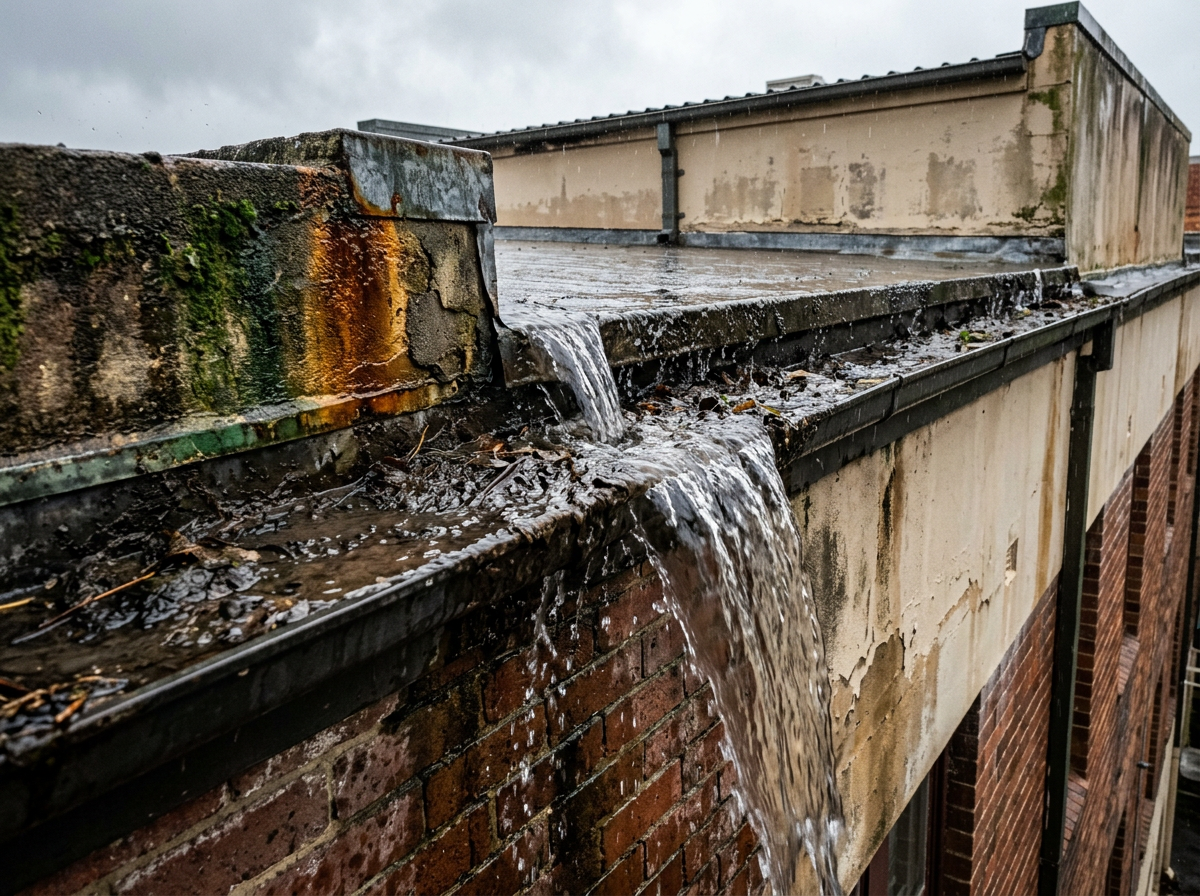
By the time the strata manager rings around, the same ring has appeared in the unit one floor down, and the lobby ceiling is starting to bubble. None of these owners did anything wrong. The water came from a blocked box gutter four storeys up that nobody had looked at since the building was handed over.
This pattern repeats across Sydney apartment stock every May. Autumn leaves drop into rooftop drainage right before the first East Coast Low arrives, and the question of who is responsible becomes urgent, expensive and often heated.
This guide explains exactly where the line sits under NSW strata law in 2026, what owners corporations must do, what lot owners and tenants can do, and how to keep small problems from becoming Tribunal disputes.
What the NSW Strata Schemes Management Act Actually Says
The starting point for every Sydney strata building is section 106 of the Strata Schemes Management Act 2015. The wording is short and the obligation is strict.
The owners corporation must properly maintain and keep in a state of good and serviceable repair the common property of the strata scheme. It must renew or replace any fixtures or fittings comprised in the common property when necessary. The duty is not optional, and it is not capped by the building's annual budget.
Roofs, eaves, fascias, box gutters, downpipes and stormwater connections are almost always common property in a Sydney strata scheme. That places the maintenance duty squarely on the owners corporation, no matter which lot ends up with the water damage.
If the owners corporation fails to comply, an affected lot owner can apply to the NSW Civil and Administrative Tribunal for orders, including damages for loss caused by the breach. NCAT has consistently treated water ingress from neglected drainage as a clear section 106 failure.
Common Property vs Lot Property: The Line That Decides Who Pays
The trickiest part of any gutter conversation is working out where common property stops and lot property begins. Get this line wrong and the wrong party ends up paying.
In a typical Sydney apartment building, common property includes:
- The main roof structure, including all valleys, box gutters and parapet flashings
- All eaves gutters and downpipes serving more than one lot
- Stormwater pits, charged lines and connections to the council main
- Roof access hatches, anchor points and walkways
- Awnings and pergolas attached to the building structure
Lot property is usually limited to the inside surfaces of the apartment itself. Anything bolted to the outside of the building, or running through internal walls to serve more than one lot, almost always sits on the common property side of the line.
Two situations regularly catch owners out:
- Townhouse and villa schemes. Some 1990s and 2000s schemes in Ryde, Eastwood and Hornsby were registered with each townhouse roof drawn as part of the lot. The strata plan controls, not common sense, so the lot owner can end up responsible for their own gutters.
- Penthouse terraces and roof gardens. A planter box, paver or membrane installed by an upper-lot owner can shift responsibility for any resulting blockage onto that owner under section 108, even when the gutter itself is common property.
If your scheme has either feature, ask your strata manager for the registered strata plan and the by-laws before booking work. The five minutes spent reading the plan can save weeks of recovery argument later.
Where the Line Gets Blurry: Balconies, Courtyards and Terraces
Balcony drainage is the single most disputed surface in Sydney strata. The slab is common property, the membrane is common property, and the drain outlet is common property, but the leaves and pot plants on top are usually the lot owner's responsibility.
If a balcony drain blocks because the resident never swept it, the resulting damage can be charged back to that lot under by-laws and section 108. If the same drain blocks because the original membrane upstand was installed below the door threshold, the cost falls on the owners corporation as a building defect.
Ground-floor courtyards in garden apartments behave the same way. The grated pit is common property, but if the resident has stacked timber decking over it, the obligation to keep it clear shifts back to them.
The practical rule that holds up at NCAT is simple. If a reasonable owner could see the blockage by looking down, the lot owner carries the duty to clear it. If clearing it requires roof access, height safety equipment, or a licensed plumber, the owners corporation carries the duty.
The Sydney Autumn-to-Winter Timing Problem
Sydney's gutter calendar runs on a tight rhythm that catches strata committees out every year. Late April through late May is when London plane, liquidambar and brushbox trees drop most of their leaf load across the Inner West, Lower North Shore and Eastern Suburbs.
The Bureau of Meteorology long-term Sydney record shows June regularly as the wettest month of the year for the metropolitan basin, with median falls above 130mm and individual East Coast Low events delivering more than that in a single day. Buildings that are not cleared between mid-May and mid-June meet winter rain with full gutters.
For owners corporations, the practical implication is that the maintenance contract needs to be scheduled, paid and completed before the end of May. A clean booked for July is a clean that arrives after the damage.
If your committee is planning the year's roof works now, our Sydney East Coast Low winter prep guide covers the storm side of the same calendar.
What Owners Corporations Must Actually Do
Section 106 sets the duty, but it does not prescribe a schedule. Sydney strata managers and roofing consultants generally agree on the following baseline for buildings up to four storeys with normal tree exposure:
- Two full gutter and downpipe cleans per year, ideally late May and late October
- One detailed roof and box gutter inspection per year with photographic record
- Quarterly cleans for buildings within 20 metres of large eucalyptus, plane or fig trees
- Monthly visual checks of accessible balcony drains by the building manager or caretaker
- Immediate make-safe response after any storm warning issued by the Bureau of Meteorology
High-rise buildings, buildings with internal box gutters, and buildings with green roofs need a custom plan. The same goes for any building where the original drainage was undersized at construction, which covers a large share of late-1960s and 1970s walk-ups across Bondi, Coogee, Kingsford and Neutral Bay.
A clear maintenance schedule, written into the ten-year capital works plan, is the cheapest insurance any committee can buy. It also forms the evidence trail that protects the owners corporation if a lot owner later claims the duty was breached.
What Happens When the Owners Corporation Fails to Maintain
The recovery path for a lot owner who suffers damage from neglected common property gutters is well established in NSW.
The owner should:
- Notify the owners corporation in writing the same day the damage is discovered, with photos and the date of the rain event.
- Mitigate further damage by moving belongings, placing buckets, and engaging a make-safe trade if the owners corporation does not act within 24 hours.
- Lodge a claim under the strata insurance policy through the strata manager.
- Keep every invoice, photo and email in a single folder for the entire claim period.
- If the owners corporation refuses to act, apply to NCAT under section 232 for orders including damages.
NCAT case law is consistent. Where a lot owner shows that water entered through neglected common property and the owners corporation cannot produce a maintenance record, the Tribunal regularly orders the owners corporation to pay rectification costs and consequential losses, including alternative accommodation.
The single most powerful piece of evidence in these matters is a recent dated invoice from a professional gutter cleaner. Buildings that can produce one rarely lose. Buildings that cannot, usually do.
Tenant, Owner-Occupier, Investor: Who Calls Who
The chain of responsibility shifts depending on who lives in the apartment when the leak appears. Knowing the order saves hours and reduces the chance that a small problem turns into a habitability complaint.
If you are a tenant, your first call is to your property manager. The property manager calls the landlord, who notifies the owners corporation through the strata manager. Do not call a tradesperson yourself unless the leak is causing immediate safety risk.
If you are an owner-occupier, your first call is to the strata manager. Lodge the issue in writing through the strata portal so there is a timestamped record. Take photos before you place a bucket.
If you are an investor with a tenanted lot, the property manager is your front line, but you should also lodge directly with the strata manager so the matter is on the record from your side. Keep the tenant informed in writing about timelines, because the NSW Fair Trading rental rules require landlords to address habitability promptly.
Strata Insurance: What It Covers and What It Quietly Excludes
Every strata scheme in NSW must carry building insurance under section 160 of the Act. The cover sounds broad, but the exclusions look very similar to the ones that catch standalone home owners.
The standard strata policy covers sudden storm damage to the building. It almost always excludes:
- Damage caused by gradual deterioration or wear and tear
- Damage made worse by a failure to maintain gutters, downpipes or drains
- Damage caused by faulty workmanship from earlier repairs
If the assessor finds a gutter blocked with two seasons of leaf litter, the storm event becomes academic. The claim is reduced or refused on the maintenance ground, and the owners corporation pays the difference from sinking funds. Our companion piece on why Sydney storm insurance claims get denied walks through the same clause from the home owner side.
The fix is identical for both. Keep dated photographic records of every clean, every repair and every inspection. Store them in the strata portal so the assessor can pull them in minutes.
What a Good Strata Maintenance Record Looks Like
Insurance assessors and NCAT members are not impressed by general assurances. They want documents. A defensible maintenance record for a Sydney strata building includes:
- A dated invoice from a licensed contractor for each clean
- Before and after photos of every gutter run and downpipe outlet
- A short written report noting any damage observed, with location references
- A copy of the contractor's public liability and workers compensation certificates
- The contractor's SafeWork NSW height safety compliance statement
Buildings that hold this record can defend almost any claim. Our team supplies all of the above as standard with every strata clean we complete, and the file is delivered to the strata manager the same week.
If your current contractor cannot provide this paperwork, the building is exposed. A quick review of last year's invoices is the fastest way to find out where you stand before winter.
Choosing a Contractor: What Sydney Strata Committees Should Look For
Strata gutter work is not the same as residential gutter work. Height, access, public liability exposure and reporting requirements all change the brief. The contractor your treasurer used at home is rarely the right fit for a four-storey block.
Look for the following before signing a contract:
- Minimum 20 million dollar public liability cover, certificate sighted
- Documented Safe Work Method Statement for each building
- Trained operators with current Working at Heights ticket
- Equipment rated for the building height, including elevated work platforms or rope access where required
- Written reporting with photos delivered within seven days of the visit
- Clear scope including box gutters, sumps, overflows and downpipe rodding
GutterFlow Solutions services strata buildings across the Lower North Shore, the Inner West and the Hills District. We use vacuum equipment that recovers debris cleanly without dropping it onto balconies below, which matters in densely populated buildings.
If you want a written quote with a sample maintenance report, you can request one through our contact form and we will respond the same business day.
A Practical Annual Calendar for Sydney Strata
The committees that avoid winter water damage tend to follow a similar yearly rhythm. The dates can shift by a fortnight for buildings near heavy tree canopy, but the structure holds.
- March: Annual roof inspection, photographic report, capital works review.
- Late May: Full gutter, downpipe and box gutter clean before the first East Coast Low.
- June to August: Visual checks after each major storm warning.
- Late October: Second full clean to clear summer growth and bird debris.
- December: Pre-storm season check of overflows and rainwater heads.
For buildings ringed by deciduous trees, add a quick interim clean in late June. For buildings near jacarandas and brushbox, add one in late November. The total cost is modest compared with a single insurance excess on a refused claim.
If your committee wants to extend the time between cleans, gutter guard installation on accessible eaves can lift the interval by six months, although box gutters and internal sumps still need the same attention.
Frequently Asked Questions
Are gutters always common property in a Sydney strata building? In almost every apartment scheme, yes. In some townhouse and villa schemes registered before the 2015 Act, individual roofs and gutters were drawn as lot property on the strata plan. Always check the registered plan before allocating cost.
Can a lot owner clean their own balcony drain? Yes, and most by-laws expect them to. Anything that needs ladder access, roof entry or height safety equipment should be left to the owners corporation contractor.
How often should a Sydney strata building clean its gutters? Twice a year is the baseline, in late May and late October. Buildings near large gum trees or planes should move to quarterly. Our Australian gutter cleaning frequency guide covers the same logic for standalone homes.
What if the owners corporation refuses to act? Notify in writing, mitigate the damage, lodge an insurance claim through the strata manager, and apply to NCAT under section 232 if the matter is not resolved. Keep every document.
Does the strata insurance excess come out of admin fund or sinking fund? The excess on building damage claims is usually paid from the admin fund, but committees can resolve to draw from the sinking fund where the loss is significant. The strata manager should bring the question to a committee meeting.
Where to Start This Week
If your committee has not booked a pre-winter clean yet, the next two to three weeks are the window. Sydney's first significant winter front usually arrives in early to mid June, and contractors fill their books fast once the first storm warning lands.
A short checklist for this week:
- Pull the last gutter cleaning invoice from the strata portal and check the date
- Ask the strata manager whether a roof inspection is scheduled before June
- Walk the top-floor common areas and look for early staining
- If anything is missing or unclear, request quotes from at least two contractors
GutterFlow Solutions provides scheduled strata gutter cleaning, box gutter and downpipe repairs, and pre-winter inspection reports across Sydney, the Central Coast and the Hunter. Reports are delivered with photos, and invoices are formatted for direct upload to your strata portal.
If you want a same-week quote for your building, the fastest path is our contact form or a direct call on 0468 057 750.
Need Your Gutters Cleaned?
GutterFlow Solutions provides fast, professional gutter cleaning across Sydney, Central Coast, Newcastle & the Hunter Region.