Sydney Termite Risk: The Winter Gutter Overflow Connection
The Sydney Winter Nobody Warns You About
Most Sydney homeowners think of termite season as summer, when the reproductive alates fly on warm humid evenings and land on window screens. That is when people call for an inspection. It is also, unfortunately, the wrong month.
The colonies that damage Sydney homes in October and November were quietly settling in during June and July. Winter is when subterranean termites are most active against buildings, not because they love the cold, but because winter is when the moisture around a Sydney foundation stays high for weeks at a time. And the single most reliable source of that moisture, in almost every case we inspect, is an overflowing or leaking gutter.
This is not a small edge-case problem. Sydney sits in a high termite pressure zone by every published mapping. If your gutters spilled water down a wall or into the ground beside your slab in June, there is a realistic chance a scout is already there. This guide walks through why, how to spot it, and what a proper winter gutter service actually does to protect the house.
The Sydney Termite Reality Most Homeowners Ignore
The species doing the damage in most Sydney suburbs is *Coptotermes acinaciformis*, sometimes called the giant northern termite despite its national spread. It is responsible for the majority of serious structural damage claims across NSW. The Australian Museum entry on termites sets out the broader picture, and the Coptotermes acinaciformis species profile confirms it is the most economically significant timber pest on the east coast.
Three things about this species matter for gutter maintenance.
- It nests in the ground, not in your walls. Every attack starts in soil and moves up.
- It needs a constant moisture source. Without water within a few metres of the colony, it cannot maintain the humidity of its galleries.
- It builds mud tubes to bridge exposed surfaces such as brick or concrete, which means it will happily cross a foundation if the reward on the other side is damp timber.
Read those three points together and the gutter connection becomes obvious. A gutter that overflows into soil near a foundation, week after week through a wet Sydney winter, is functionally a permanent underground pond. That is the invitation.
Why Winter, Not Summer, Is the Danger Window
Sydney's rainfall record, published in the long-term Bureau of Meteorology climate data, shows winter rainfall is often longer and slower than summer rainfall. Summer gives you a 40 mm storm that runs off in an hour. Winter gives you three days of soft persistent rain that soaks the ground and stays there.
For a termite colony scouting a new food source, those two rainfall patterns behave very differently.
- A summer storm floods a colony gallery briefly, then drains. Colonies close nearby foraging tubes and wait.
- A winter rain event saturates the soil for a fortnight. Colonies expand foraging tubes into the newly wet zone because it is easier to work in and keeps their bodies from drying out.
- If the wet zone happens to sit against a timber-frame wall with a sub-floor vent or a stepped brick pier, the colony has a direct pathway upward.
That is why the calls we take in October about mud trails on skirting boards trace back, almost every time, to a gutter that was already failing in June. Winter is when the pathway forms. Spring is when the damage becomes visible.
How an Overflowing Gutter Actually Attracts Termites
The mechanism is not complicated once you see it laid out. It runs in four steps, and all four are visible from the ground if you know what to look for.
The moisture pathway
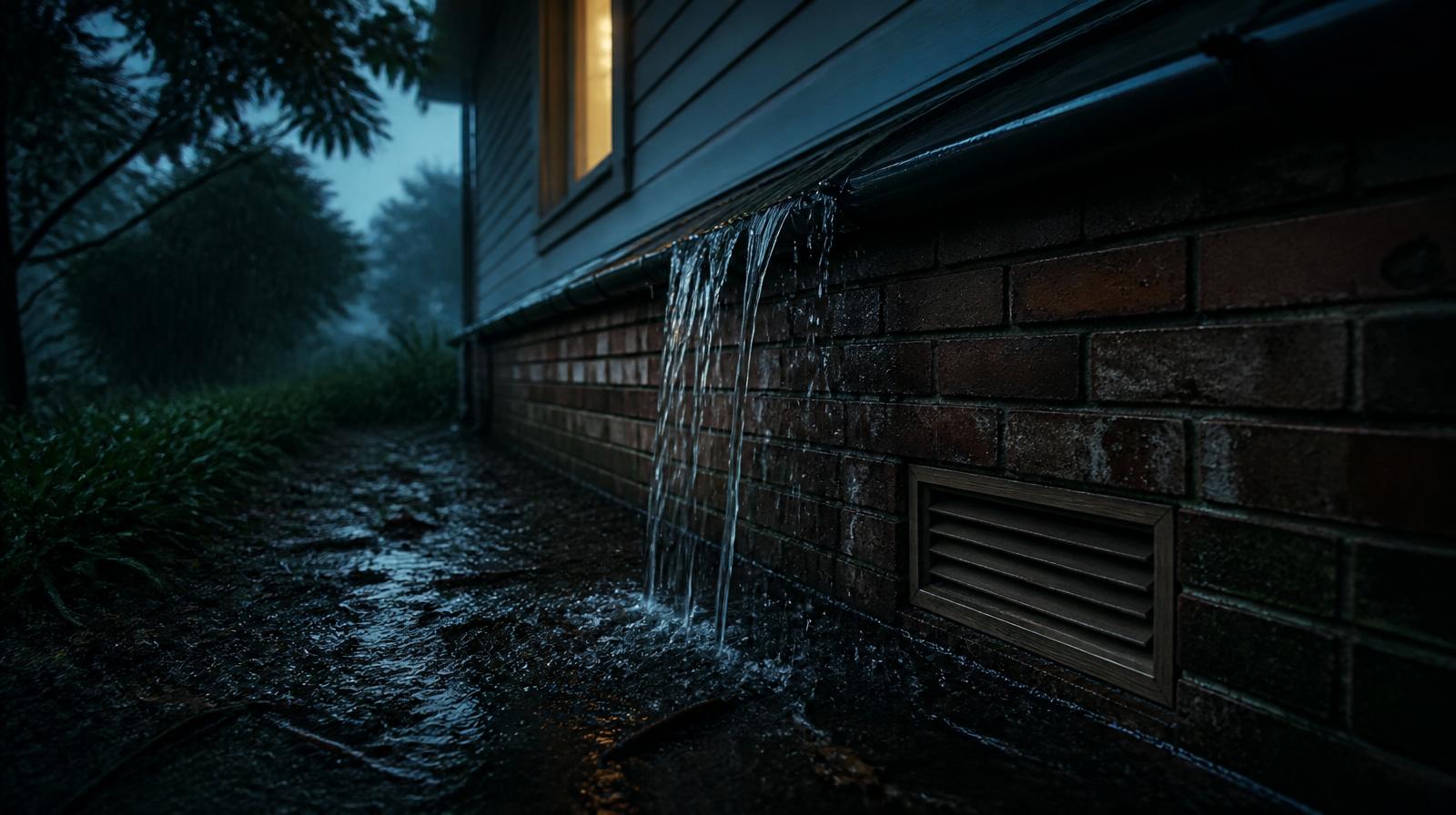
An overflowing gutter drops water down the outside of the wall and pools in the soil at the base of the foundation. In a Sydney winter that soil stays saturated for weeks. Termite scouts sample soil moisture continuously, and constant-wet soil against a building is a strong positive signal. Once the colony commits foragers to that zone, mud tubes begin appearing on the outside of the brick or up the pier stumps within one to two months.
The timber pathway
Overflow does not stop at the soil. It also soaks the fascia, the eaves, and the top plate of the wall behind the gutter. That timber softens as it absorbs moisture, and softened timber is far easier for termites to attack than kiln-dried framing. The AS 3660.1 Termite management standard explicitly identifies moisture control and drainage as primary parts of building-side termite management, alongside chemical and physical barriers.
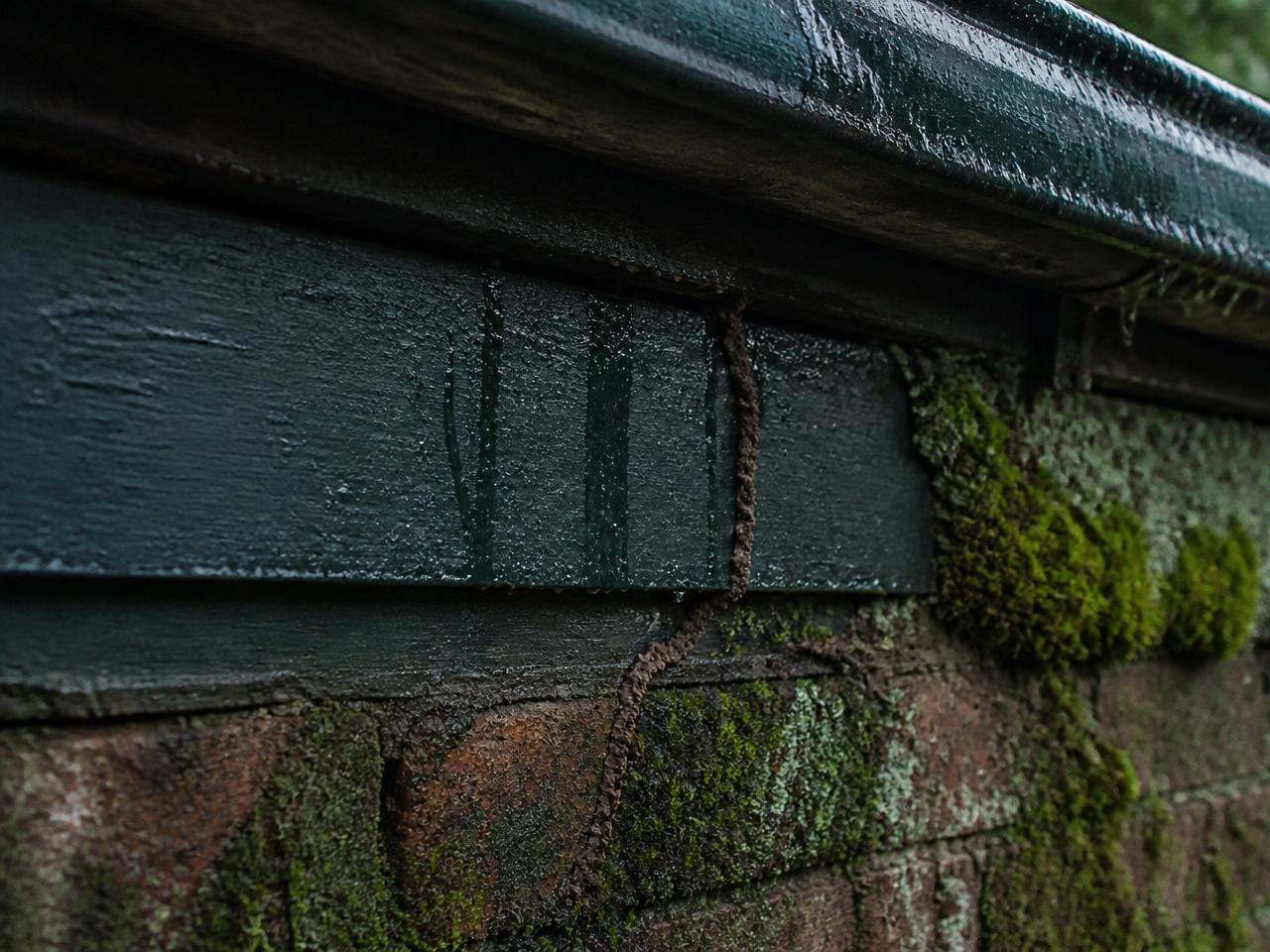
Together, wet soil at the base and wet timber above give the colony both the humidity it needs and the food source it wants. The gutter is the bridge.
The Signs on the Outside of Your Home Right Now
You do not need a ladder to check for the early-stage pattern. Walk the perimeter of your house this week and look for the following at ground level and up to eye height.
- Persistent damp patch in the garden bed against the wall. Any bed that has stayed muddy for more than five days after the last rain is holding water it should not be holding.
- Efflorescence on the brickwork. The white powdery bloom on bricks is salt drawn out of the wall by prolonged moisture. It marks the exact zone where water is passing through.
- Moss or lichen on the bottom two brick courses. These plants need constant moisture and mark the wet zone precisely.
- A pencil-thick mud tube on the outside of the brick or pier. This is the signature of an active colony bridging from soil to timber. If you see one, do not disturb it. Photograph it and call a licensed pest inspector the same day.
- A rotting fence post or garden retaining sleeper within three metres of the house. Colonies use those as staging posts before crossing to the house.
Two or more of these signs together, in the same corner of the house, is enough to justify both a gutter service and a professional termite inspection.
The Signs Inside Your Walls
The interior signs come later, and by then the colony has usually been active for months. They are still worth knowing.
- Skirting boards that sound hollow when tapped, especially in rooms on the wet-corner side of the house.
- Faint blistering or ripples in plasterboard along a wall that shares a corner with a damp exterior spot.
- Doors and windows in one specific corner of the house that suddenly stick or drop out of alignment.
- A faint musty or mushroom-like smell in a cupboard against an external wall.
- Small piles of what looks like fine sawdust or coffee grounds along a skirting, which are termite frass.
If any of those appear, stop investigating yourself and call a pest inspector. Poking a suspected gallery with a screwdriver can send the colony into shutdown and make it harder to trace.
Sydney Suburbs Where the Risk Concentrates
Termite pressure is not evenly distributed across the metro area, and neither is gutter overflow. The homes we see with the worst combined risk sit in a few consistent patterns.
- Inner-west heritage terraces from Newtown through Marrickville, Petersham and Dulwich Hill. Original box gutters, soft-fired brickwork and small side lanes that trap moisture make these a textbook case. We wrote about the gutter side of this pattern in the Sydney box gutters winter guide.
- North Shore homes with heavy gum and jacaranda overhang. East Killara, Roseville, Wahroonga and Turramurra all see rapid autumn debris load that carries straight into winter overflow, especially on the bushland side.
- Northern Beaches homes on sandy soil with sub-floor timber. Sandy soil drains fast when the gutter is working and stays wet against the foundation when it is not, which creates a sharp moisture gradient right where the wall meets the ground.
- Central Coast and Hunter homes with large single-storey footprints. Long gutter runs, older downpipe layouts and heavy winter rainfall combine to overload systems that were sized for a different climate.
- Bushland fringe properties near national parks. Duffys Forest, Terrey Hills, Berowra and similar suburbs get the double hit of eucalyptus debris loading and constant termite pressure from nearby forest colonies.
If your street matches one of those patterns, treat gutter overflow as a termite trigger, not just a water problem.
What Australian Standards Actually Require
Any conversation about termites and buildings in Australia comes back to two documents. The first is the National Construction Code, which requires a termite management system for most residential construction. The second is AS 3660.1 Termite management for new building work, which sets out how those systems work in practice.
Two points from AS 3660 matter for existing homeowners.
- The standard treats drainage and moisture control as part of the termite management system, not as a separate maintenance issue. A blocked gutter is, in the standard's own logic, a partial defeat of the termite barrier.
- The standard assumes ongoing inspection. A physical or chemical barrier installed at construction stops working the moment moisture starts pooling against the wrong part of the slab or pier. The gutter is the single easiest way to create that moisture without noticing.
For consumers, the NSW Fair Trading termite protection page is the plain-English version of the same guidance. It reinforces that keeping water away from the perimeter is the homeowner's responsibility, and it is one of the few termite variables you can control without a licensed pest technician.
The industry body AEPMA covers the pest-management side of the same picture, and its consumer guidance repeatedly returns to moisture control as the front line of prevention.
The Winter Gutter Fix That Cuts Termite Risk
If you have not had gutters serviced since autumn, the checklist below is what a proper winter service should include for a termite-pressure Sydney home. This is not a leaf blow.
- Full hand or vacuum removal of compacted debris from every metre of trough, including valleys and any box gutter sections.
- Individual downpipe flush with a pressurised hose to confirm the stormwater line is clear all the way to the pit or the street kerb. Most winter overflow traces back to a single blocked outlet rather than the trough itself.
- Inspection of every downpipe discharge point at ground level. Water should be leaving the property, not soaking the garden bed against the wall. If a downpipe empties within 300 mm of the foundation, that is a termite invitation and needs a spreader or a rigid extension.
- Visual inspection of fascia, eaves, sub-floor vents and the first two brick courses for existing moisture staining, moss, or mud tubing.
- Written report and dated before and after photos. This paper trail is what protects you if a termite claim ever ends up in front of an insurer, and it is what a pest inspector will ask for when they investigate the moisture source.
Our own gutter cleaning and gutter vacuuming services follow that exact sequence. If a quote you get is missing steps three, four or five, it is not a termite-aware service, whatever the price.
For homes with chronic overflow, the longer-term answer is often a properly specified gutter guard combined with corrected downpipe discharge. The Sydney gutter guard guide breaks down which mesh types actually work in gum-heavy areas and which are a waste of money.
If your downpipes are the size that was standard in the 1970s and you now get regular overflow in moderate rain, the drainage is probably underspecified for modern storm intensity. Our Sydney downpipe sizing guide walks through the AS/NZS 3500.3 maths on that.
When Damage Is Already Done: What to Do This Week
If you have read this far and you are recognising warning signs in your own home, work the problem in this order.
- Document everything before you touch it. Photograph every damp patch, mud tube, moss line and interior blister. Note the date. This becomes evidence.
- Book a licensed timber pest inspector. Not a general pest sprayer, a licensed timber pest inspector who can write a report against AS 3660. Do this before any exterior work that might disturb an active colony.
- Book a proper gutter service with written before and after photos. The gutter has to come out of the moisture equation regardless of the termite outcome.
- Fix downpipe discharge points. Any downpipe emptying within 300 mm of the wall needs to be extended to at least a metre away, ideally into a stormwater pit or a spreader.
- Check the drainage grade. Soil next to the house should fall away from the wall, not back toward it. Even a shallow reverse fall traps water where you least want it.
- Keep the paper trail. A dated report, dated photos, a pest inspection and a plumber or builder invoice together form the record most insurers will ask for if a claim ever arises. We wrote about the same paper-trail logic in the context of Sydney storm insurance claims.
Do not attempt DIY chemical treatments around a suspected active colony. The colony can retreat and re-emerge somewhere less visible, which is the worst possible outcome. Fix the moisture, then let a licensed technician handle the pest side.
The Damage Numbers Nobody Puts on the Fridge
Termite damage repair on a Sydney home routinely runs into five figures once wall frames and structural bearers are involved. A single winter of gutter overflow is not what causes that number on its own, but it is very often the trigger event that unlocks it, and it is the one variable a homeowner can control without a specialist licence.
By comparison, a full winter gutter service for most Sydney single-storey homes sits between $200 and $350. We break that down in detail in the gutter cleaning cost guide. The economics are lopsided in an uncomfortable way, and the July window is the one that matters.
The SafeWork NSW fall-from-height statistics also make clear why doing this yourself in winter is a bad trade. Wet metal roofs, ladder feet slipping on wet paving and slippery moss on brick are the exact conditions that push the ladder injury numbers up every June and July. Our DIY ladder safety piece covers that risk in more depth.
Frequently Asked Questions
Can a blocked gutter really attract termites?
Not directly, but yes indirectly. A blocked gutter overflows water into the soil against the foundation and soaks the timber above the trough. Subterranean termites need constant moisture to survive, and softened timber to eat, so the overflow creates both conditions in the same place. Colonies that would have foraged elsewhere follow the moisture gradient toward the house.
How quickly can termites establish after gutter overflow starts?
For a colony already scouting in the area, mud tubes can appear on the outside of a foundation within one to two months of a constant moisture source becoming available. For a new colony to form from a spring swarm, allow a season or two. Either way, winter overflow is what tips a slow-forming problem into an active one.
Do I still need annual termite inspections if my gutters are clean?
Yes. Clean gutters remove one major risk factor but do not remove termite pressure from the surrounding soil, neighbouring properties or garden timbers. Annual professional timber pest inspections remain the industry standard for all Sydney homes.
What does AS 3660 actually require for existing homes?
AS 3660.1 is written for new building work, but its principles apply to existing homes through the National Construction Code and standard insurance conditions. In plain language, it treats drainage, moisture control and access for inspection as part of the termite management system.
My home has a full termite chemical barrier. Am I safe from gutter overflow?
Chemical barriers reduce risk, they do not eliminate it. Barriers can be bridged by mud tubes over the treated zone, and prolonged moisture near the barrier can accelerate its breakdown. Keeping the perimeter dry is what preserves the barrier.
Is any of this covered by home insurance?
Termite damage itself is almost universally excluded from Australian home insurance. Storm damage from a genuine one-off event may be covered, but gradual overflow from poor maintenance is not. Documented gutter maintenance is what protects the adjacent water-damage side of any claim.
How often should Sydney homes with termite pressure service their gutters?
Twice a year is the sensible minimum, once after autumn leaf drop and once before summer storm season. Homes with heavy gum, jacaranda or liquidambar overhang usually need three to four cleans a year, or a properly fitted gutter guard. See the how often to clean gutters in Sydney guide for the fuller schedule.
The July Decision That Protects Your House Through Spring
Sydney's termite calendar does not match what most homeowners assume it does. The visible flying-alate season in November is the end of a process that started, in almost every case we inspect, with a wet winter and an unlucky gutter. If yours is overflowing this month, that is the trigger event, and July is the last useful window to shut it down before the spring foraging season expands.
Fixing gutters is not a termite treatment. But it removes the single most controllable variable on the homeowner side of the equation, and it does so at a fraction of the cost of the damage it prevents.
If your roofline is anywhere across Sydney metro, the Central Coast, Newcastle or the Hunter, our team services every kind of guttering, from heritage terrace box gutters to modern Colorbond fascia systems, with the perimeter drainage check baked into every job.
📞 Call 0468 057 750 for a same-week winter inspection, or request a free written quote. Every service comes with before and after photos, a written record and a downpipe discharge check you can hand to your pest inspector.
Need Your Gutters Cleaned?
GutterFlow Solutions provides fast, professional gutter cleaning across Sydney, Central Coast, Newcastle & the Hunter Region.